A polymer lower is a reasonable choice for a light, fixed-stock or low-round-count AR-15, but it saves ounces, not pounds, and very few are on sale. A forged 7075 aluminum stripped lower weighs only about 8.35 oz (Aero Precision's Gen 2, per its listed specs), so a polymer stripped lower can save a few ounces at most. The bigger savings come from designs that mold other parts into the receiver: KE Arms' KP-15 includes the stock, buffer tube, pistol grip and trigger guard, and Recoil weighed a complete KP-15 lower at 25.5 oz, about 10 oz lighter than a standard carbine lower.
Correction: an earlier version of this article said a polymer lower is 1.5 lb lighter than aluminum. That was wrong, and has been fixed.
Polymer vs aluminum lowers
| Polymer | Aluminum (forged or billet) | |
|---|---|---|
| Material | Glass-filled nylon (the KP-15 is 30% glass-filled) | 7075-T6 aluminum, anodized |
| Weight | A few ounces less stripped; about 10 oz less as an integrated complete lower | About 8.35 oz stripped (forged) |
| Corrosion and finish | Color runs through the part; scratches do not show bare metal | Anodizing can wear through to bare aluminum |
| Weak point | Buffer tube threads and rear takedown area | Rarely fails in normal use |
| Stock options | Integrated designs have a fixed stock (KP-15: 13 in length of pull) | Any buffer tube and stock |
| Availability (2 Nov 2026) | None in stock at the stores we track | Many makers, many in stock |
Why a polymer lower is strong enough, and where it fails
The lower receiver carries none of the firing pressure: the bolt locks into the barrel extension, which is held by the upper. That is why polymer can work at all. The load a lower does take comes through the stock. The buffer tube screws into a ring at the back of the receiver, and the stock acts as a lever on it every time the rifle is dropped, leaned on or butt-stroked. On all-polymer lowers that ring and the rear takedown lug next to it are where cracks and stripped threads show up, and over-tightening the castle nut makes it worse.
Makers have attacked that weak point two ways:
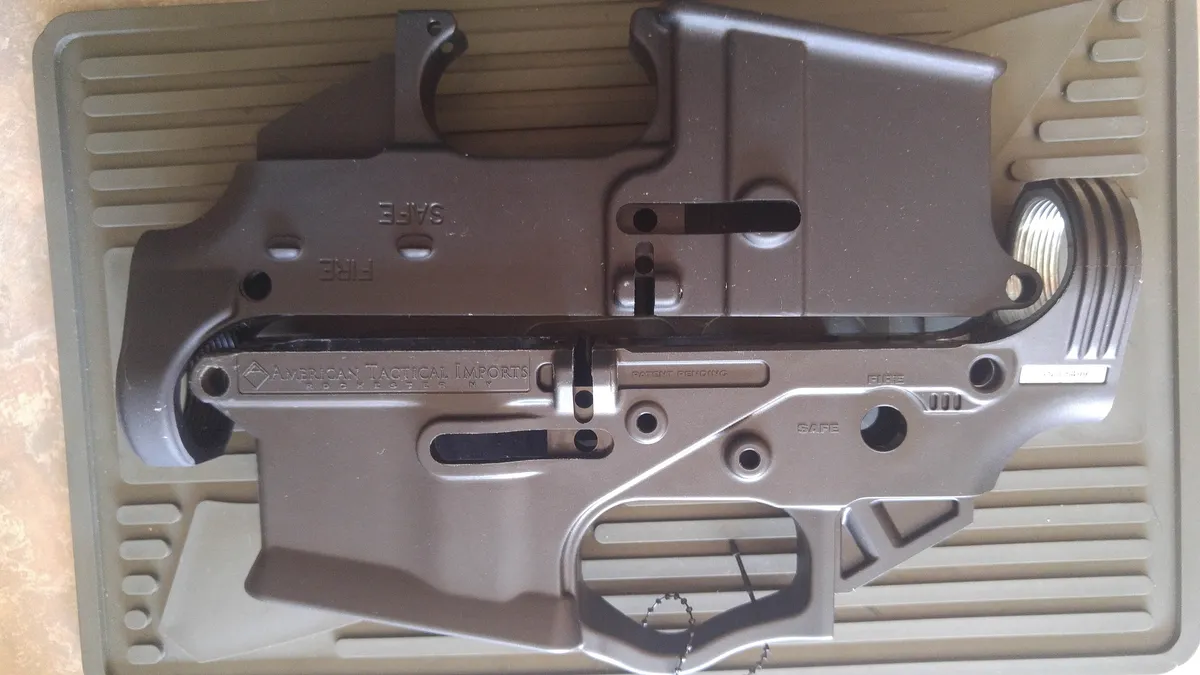
- Metal inserts. ATI's Omni Hybrid (pictured at the top) molded a metal insert around the buffer tube ring and rear takedown pin (TFB review).
- No threads at all. The KE Arms KP-15 molds the buffer tube and stock into the receiver, so there is no threaded joint to fail. The trade-off is a fixed 13 inch A1-length stock.
Who should buy a polymer lower
- Good fit: a light hiking or truck rifle, a retro or fixed-stock build, or a trainer that sees modest round counts.
- Choose aluminum: for an adjustable stock, hard use, a duty rifle, or an AR-10, and whenever you want the widest choice of parts. Polymer AR-10 lowers are rare.
Both are the serialized firearm, so either one ships to a dealer for a background check; KE Arms sells the KP-15 only to buyers 21 and over. Unfinished polymer lowers are a separate legal question: see 80% lowers explained.
What to buy if no polymer lower is in stock
On 2 November 2026 none of the polymer lowers in our catalog, including every KP-15 version, was in stock at any store we track, and KE Arms listed the stripped KP-15 as out of stock. If weight is the goal, a forged aluminum lower with a light stock gets most of the saving. Compare lower receivers with today's prices, read billet vs forged and complete vs stripped, or start a build in the AR-15 builder.
Frequently asked questions
Are polymer AR-15 lowers safe?
Yes. The lower takes no firing pressure. The risk is cracking or stripped threads at the buffer tube, not a dangerous failure while firing.
How much lighter is a polymer lower?
A few ounces as a stripped receiver, because a forged aluminum stripped lower is only about 8.35 oz. Integrated designs like the KP-15 save about 10 oz as a complete lower.
Do polymer lowers break?
All-polymer lowers have cracked at the buffer tube ring and rear takedown lug. Metal inserts or an integrated buffer tube avoid that weak point.
Can I use any stock on a polymer lower?
On a polymer lower with a threaded buffer tube ring, yes. Integrated designs like the KP-15 have a fixed, molded stock.
Do polymer lowers corrode?
No. Polymer does not corrode, and its color runs all the way through, so scratches do not expose bare metal.