Short answer (checked 11 October 2026): you no longer need ATF approval to build an AR-15 SBR, and there is no $200 tax stamp. Congress cut the making tax to $0 on January 1, 2026, and since October 9, 2026 ATF has stopped enforcing the NFA's approval and registration rules for short-barreled rifles (and short-barreled shotguns, suppressors and "any other weapons"). Filing a Form 1 is now voluntary. If your state requires NFA registration or federal compliance, register anyway. It is also still illegal to ship one across state lines without a Form 20, sell one to a resident of another state, or possess one if you are a prohibited person. This is an enforcement policy, not a repeal, and ATF warns it can change.
This is general information, not legal advice. Rules last checked against ATF's own guidance on 11 October 2026; we re-check every six months.
What counts as a short-barreled rifle?
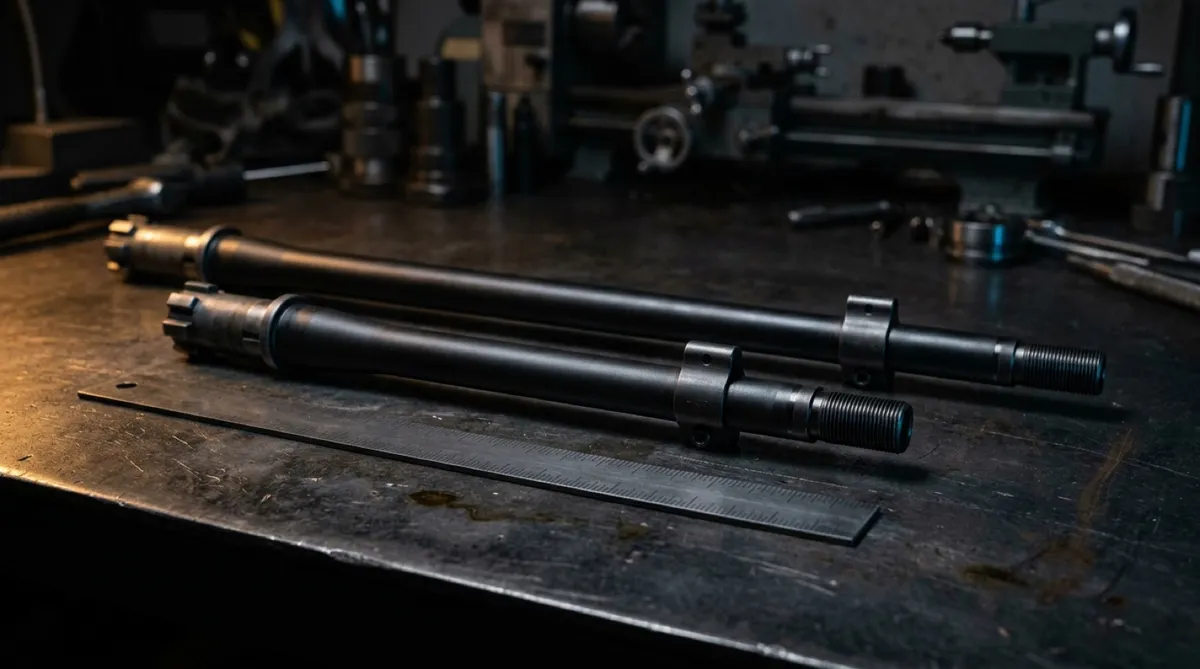
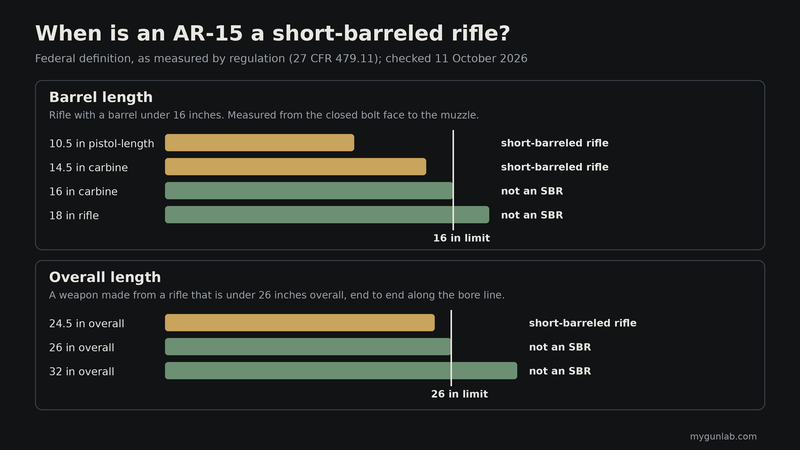
Federal law (26 U.S.C. 5845(a)) treats two things as short-barreled rifles: a rifle with a barrel under 16 inches, and a weapon made from a rifle that is under 26 inches overall. A rifle is a weapon intended to be fired from the shoulder. Barrel length is measured from the muzzle to the face of the closed bolt, and overall length along the line of the bore, per 27 CFR 479.11. So an AR-15 with a 10.5-inch barrel and a stock is an SBR, while the same upper on a pistol lower with no stock is a pistol. Putting a stock on that pistol is what makes it a short-barreled rifle.
What changed in 2026
| Date | What happened |
|---|---|
| July 4, 2025 | The One Big Beautiful Bill Act (Pub. L. 119-21) cuts the NFA making and transfer tax to $0 for SBRs, short-barreled shotguns, suppressors and "any other weapons". Machine guns and destructive devices stay at $200. |
| January 1, 2026 | The $0 tax takes effect. Form 1 still required approval at this point. |
| August 5, 2026 | A federal court in Texas (Silencer Shop Foundation v. ATF) rules the NFA's making, registration and transfer rules can no longer be justified as taxes for these items. The injunction covers only the plaintiffs, their members and customers. |
| October 9, 2026 | ATF says it will not enforce those rules against anyone: no prior approval to make or transfer, no registration, no ban on possessing or moving unregistered items, no NFA marking requirement. ATF still accepts forms voluntarily. |
Sources: ATF, Update to NFA Transfer Guidance (last updated October 9, 2026) and 26 U.S.C. 5821.
What you still have to follow
- The Gun Control Act. SBRs are still firearms. Dealers must run a Form 4473 and a background check, and nobody may sell one to a person who is prohibited from having a firearm.
- Form 20 for interstate travel. ATF says you must still file a Form 20 before taking an SBR across state lines, registered or not (18 U.S.C. 922(a)(4)).
- No selling to other states or in business. Individuals may not transfer one to a resident of another state, or make or sell them as a business, without the proper licenses.
- Serial numbers. Possessing one with an obliterated serial number is still a federal crime.
- State and local law. ATF says its policy does not change state law. A minority of states ban SBRs outright, and most require NFA items to be federally registered or compliant. ATF cannot say whether an unregistered SBR counts as lawfully held under your state's law.
Should you register anyway?
Our answer: yes, if your state requires NFA registration or federal compliance. ATF says most states do, and an unregistered SBR may not satisfy them. A state ban is different: registering does not make an SBR legal where it is banned.
Elsewhere, registering is optional, and there are reasons both ways:
- For: ATF warns enforcement could resume if Congress adds a new tax, the court order is overturned or ATF rescinds the policy. Unregistered NFA items are treated as contraband and there is no automatic grandfathering; later registration happens only if the Attorney General declares an amnesty. Registration is still free ($0).
- Against: it is a record of ownership, and ATF says that once an item is removed from the registry it cannot be registered again without an amnesty.
If you are unsure, ask a firearms attorney or your state's attorney general. If enforcement returns, penalties for an unregistered NFA firearm run up to 10 years in prison (26 U.S.C. 5871), with fines up to $250,000 under 18 U.S.C. 3571.
How to register an SBR with Form 1
Form 1 (Application to Make and Register a Firearm) can be filed on paper or through ATF eForms, which offers Forms 1 and 20. Check the current form and its instructions, since ATF has been changing them.
- Decide who registers. You can register as an individual, or as a trust or company. Everyone who is a "responsible person" on a trust or company must also submit fingerprints and a photo (ATF final rule 41F).
- File the form. The tax on the form is $0. Individuals attach a photo and fingerprint cards, and the form asks you to notify (not get permission from) your local chief law enforcement officer.
- Wait for approval before you build. Approval registers the SBR to you. If you file a Form 1, wait for it before you assemble the rifle, as was always the rule. ATF gives no processing time.
- Mark the receiver. The marking rule, 27 CFR 479.102, is your name, city and state and a serial number, engraved at least .003 inch deep and at least 1/16 inch tall. ATF is not enforcing the NFA marking requirement now, but mark it as the rule describes if you register.
How to build an AR-15 SBR
There are three routes:
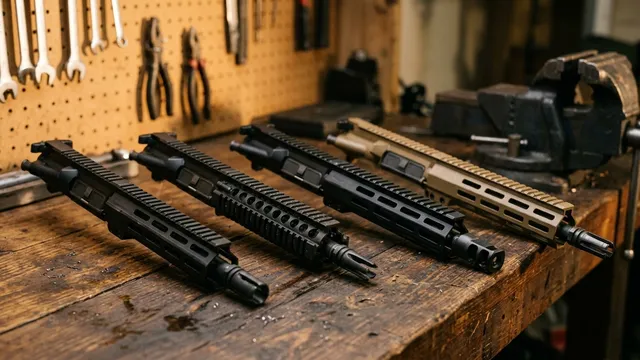
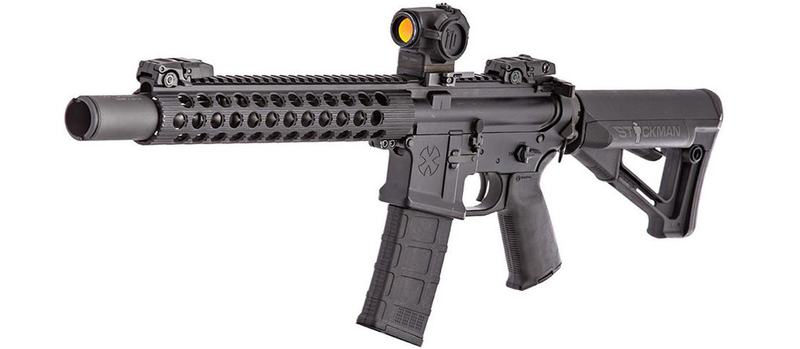
- Short upper on a rifle lower. The simplest: swap a 7.5" to 14.5" upper onto a lower with a stock. The result is an SBR once assembled.
- AR pistol plus a stock. Buy a pistol, and add a stock and a rifle buffer tube. Adding the stock is what makes it an SBR.
- Buy one made. Dealers face a separate Gun Control Act rule (18 U.S.C. 922(b)(4)) and ATF says there is no approval route for dealers to sell SBRs yet. ATF will not enforce it until it writes one. Dealers can sell only to residents of their own state.
Short barrels need the right parts: a pistol-length or carbine gas system (see our gas system length chart), a heavier buffer if the rifle is over-gassed (buffer weights), and a muzzle device that suits the noise (muzzle brake vs compensator vs flash hider). 300 Blackout and 9mm lose less performance than 5.56 in a short barrel; our 300 Blackout BCG guide covers parts.
Compare 10.5-inch barrels and upper receivers by price, then check the whole build in the AR-15 builder.
Short-barrel starting points, today's prices
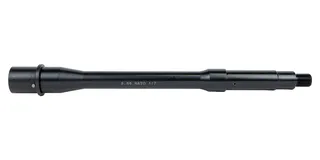
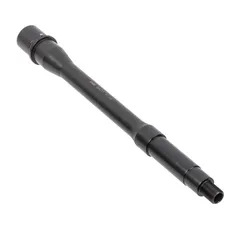
PSA 10.5" 5.56 carrier-length barrel
Pros
- Low price for a 10.5" 5.56 barrel
- Nitride
Cons
- Barrel only: you add the rest
Barrel, 5.56
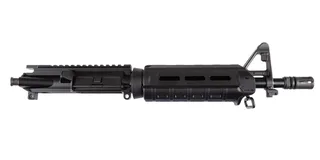
PSA 10.5" 5.56 MOE pistol upper
Pros
- Complete upper, no BCG or charging handle
- Good price
Cons
- Bring your own BCG and charging handle
Upper, 5.56
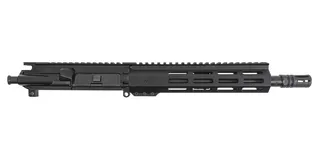
PSA 10.5" 300 Blackout M-LOK upper
Pros
- Pistol-length 300 BLK
- Lightweight M-LOK rail
Cons
- Needs 300 BLK mags and buffer setup
Upper, 300 Blackout
PSA 10.5" 9mm barrel
Pros
- 9mm PCC barrel, melonite
- Low price
Cons
- Needs a 9mm bolt and mag well
Barrel, 9mm
Is an SBR worth it?
- Handling: a short rifle is easier to move through doorways and vehicles, lighter and quicker to point.
- Calibers: 300 Blackout and 9mm lose little velocity from a short barrel; 5.56 loses the most.
- Downsides: more muzzle blast and noise, less velocity at range, and extra rules to follow (Form 20 for travel, state law, and the risk the policy changes).
Thinking of 300 Blackout for a short barrel? See its published velocity, energy and drop in our 300 Blackout ballistics chart.
Not planning a stock? See how to build an AR pistol instead.
Suppressors fall under the same ATF guidance; see how suppressors work and the October 2026 rules.
The same October 2026 change covers suppressors; see how to buy a suppressor in 2026.
Frequently asked questions
Do I still need a tax stamp for an SBR?
No. The making tax is $0 as of January 1, 2026 (26 U.S.C. 5821), and since October 9, 2026 ATF no longer requires approval or registration. You can still file a Form 1 voluntarily at $0.
Is ATF Form 1 still required to make an SBR?
Not by ATF: it says unlicensed individuals no longer need to file a Form 1 and get approval. Your state may still require federal compliance or registration, so check state law first.
Should I register my SBR?
Yes if your state requires NFA registration or federal compliance. Elsewhere it is optional: it protects you if enforcement returns, but removal from the registry is permanent.
Can I take an SBR across state lines?
Yes, but you must file an ATF Form 20 first, even if the SBR is not registered. You cannot sell or transfer it to a resident of another state.
Could this change?
Yes. ATF says enforcement could resume if Congress adds a tax, the court injunction is overturned or the policy is rescinded. There is no automatic grandfathering.
I already registered my SBR. Should I remove it?
ATF will remove it if you write to the NFA Division, but you cannot re-register it later without an amnesty. If your state requires registration, keep it registered.
Is a pistol with a stock an SBR?
Yes, if the barrel is under 16 inches: a rifle intended to be fired from the shoulder with a barrel under 16 inches is a short-barreled rifle.