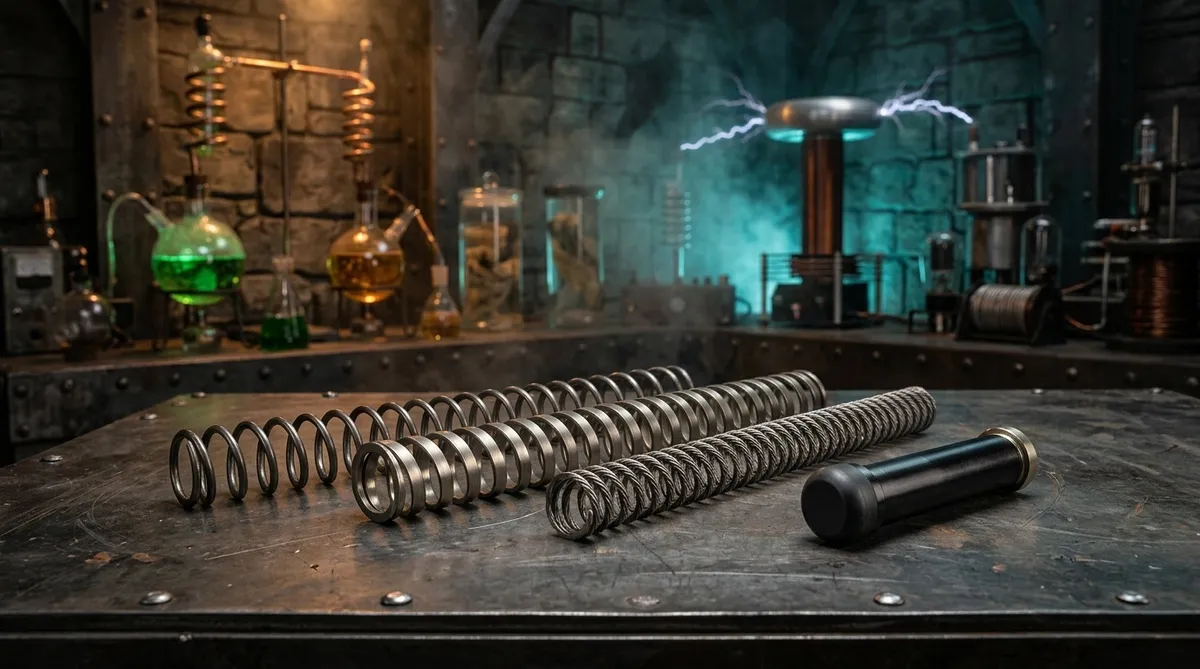
Short answer: use the spring that matches your buffer tube: a carbine spring in a carbine tube, a rifle spring in a rifle (A2) tube. A standard spring works; upgrades such as Geissele's braided Super 42, flat wire springs from Tubb and Strike, and JP's polished springs aim for smoother, quieter cycling and longer life. Some springs need their own buffer or tube, so check before mixing parts. Replace a spring that is kinked, rusted, or noticeably shorter than a new one of the same type.
The main types
Carbine vs rifle springs
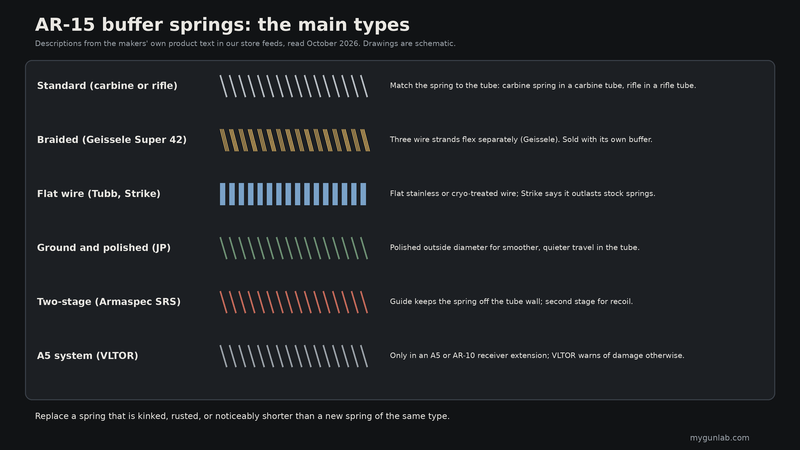
The spring must match the length of your receiver extension: collapsible-stock rifles use a carbine tube and carbine spring; fixed A2-style stocks use the longer rifle tube and rifle spring. JP, Geissele and others sell both lengths. Some systems are their own thing: VLTOR's A5 spring and buffer work only in an A5 or AR-10 short receiver extension, and VLTOR warns that using them in a regular carbine tube will cause damage. See buffer tube types and mil-spec vs commercial tubes.
Upgrade springs
- Braided: Geissele's Super 42 uses three independent strands of wire that flex separately, which Geissele says damps vibration and absorbs energy. The carbine version is sold with Geissele's buffer, and retailers note the spring won't fit over a standard buffer.
- Flat wire: Tubb makes a stainless flat-wire spring for carbine and rifle tubes; Strike says its cryogenically stress-relieved flat wire spring outlasts the stock spring.
- Ground and polished: JP grinds and polishes the outside diameter for smoother, quieter travel in the tube.
- Two-stage: Armaspec's SRS keeps the spring off the tube wall and adds a second stage meant to reduce felt recoil.
- Power-rated: Sprinco color-codes its springs by power, for example red for carbine-gas 16 inch rifles and blue for mid-length gas.
Springs and buffers work together
A heavier buffer or stronger spring slows the bolt; too much for your gas system and ammo can stop it cycling. Change one thing at a time. See AR-15 buffer weights and adjustable gas blocks.
When to replace a buffer spring
Replace it if it is kinked, rusted or visibly damaged, or if it is noticeably shorter than a new spring of the same type. Springs are cheap, so many owners keep a spare.
Buffer springs, with today's prices
Lowest price across the stores we track:
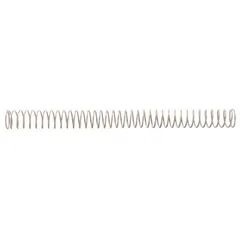
Luth-AR carbine buffer spring
Pros
- Standard factory-replacement carbine spring
Cons
- Basic spring
Standard
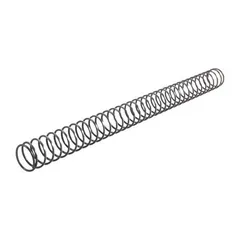
JP Enterprises tuned carbine buffer spring
Pros
- Ground and polished for quieter travel
Cons
- Carbine tube only
Polished
Geissele Super 42 spring and buffer, carbine
Pros
- Three-strand braided spring
- Sold with Geissele's buffer
Cons
- Needs its matching buffer
Braided
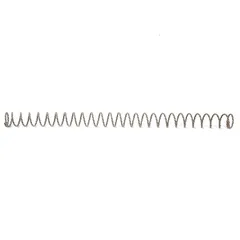
Geissele Super 42 rifle-length spring
Pros
- Braided spring for rifle-length tubes
Cons
- Rifle tube only
Braided, rifle
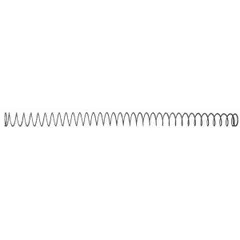
Tubb flat wire buffer spring, stainless
Pros
- Stainless flat wire
- Carbine and rifle tubes
Cons
- Single store listing
Flat wire
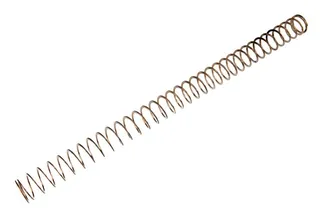
Strike Industries carbine flat wire spring
Pros
- Flat wire, cryogenically stress relieved
Cons
- Carbine tube only
Flat wire

Armaspec SRS Gen4 C stealth recoil spring
Pros
- Two-stage; keeps the spring off the tube wall
Cons
- Carbine version on this listing
Two-stage
Compare all buffer tubes, buffers and springs.
Frequently asked questions
Are carbine and rifle buffer springs the same?
No. A rifle spring is longer and goes in a rifle (A2) buffer tube; a carbine spring goes in a carbine tube.
When should I replace my AR-15 buffer spring?
When it is kinked, rusted or damaged, or noticeably shorter than a new spring of the same type.
Is a flat wire buffer spring better?
Makers such as Strike say flat wire springs outlast stock springs and cycle more smoothly. A standard spring still works.
Can I use a Geissele Super 42 spring with my buffer?
Use it with Geissele's buffer; retailers note the Super 42 spring won't fit over a standard buffer.
Does a buffer spring affect recoil?
Spring and buffer together control how fast the bolt moves, which changes how the rifle feels; two-stage springs such as Armaspec's SRS are sold to reduce felt recoil.