Short answer (checked 11 October 2026): a forced reset trigger (FRT) is a semi-automatic AR-15 trigger that mechanically pushes the trigger forward after each shot, so you can fire quickly while keeping rearward pressure on it. Under current federal law it is not a machinegun: the Supreme Court's 2024 Cargill decision and a July 2024 Texas federal ruling led the Department of Justice to settle with Rare Breed Triggers on May 16, 2025. It is still banned in some states, the legal reasoning can be revisited, and real machinegun conversion devices (auto sears, "switches") remain illegal federal machineguns.
General information, not legal advice. We sell nothing ourselves: prices come from the retailers we track. This guide gives no instructions for installing or modifying anything. Check your state's law before you buy.
What is a forced reset trigger?
In an ordinary semi-automatic trigger you pull, the gun fires once, and you let the trigger come forward before pulling again. A forced reset trigger uses the energy of the gun cycling to push the trigger forward for you, so a shooter who keeps pressing rearward fires again as soon as it resets. Whether each shot takes its own function of the trigger is the question the courts applied. It is not a binary trigger, which fires on the pull and again on the release (see our best AR-15 triggers and trigger comparison).
Why is a forced reset trigger not a machinegun?
The federal definition (26 U.S.C. 5845(b)) covers a weapon that shoots, or can be readily restored to shoot, "automatically more than one shot, without manual reloading, by a single function of the trigger," plus parts designed and intended solely and exclusively to convert a weapon into one. In Garland v. Cargill (June 14, 2024, 6-3) the Supreme Court held that a bump stock cannot fire more than one shot "by a single function of the trigger," so ATF exceeded its authority by classifying bump stocks as machineguns. A month later the Northern District of Texas applied that reasoning to forced reset triggers and concluded they cannot be classified as machineguns either. The Justice Department then settled instead of continuing its appeals.
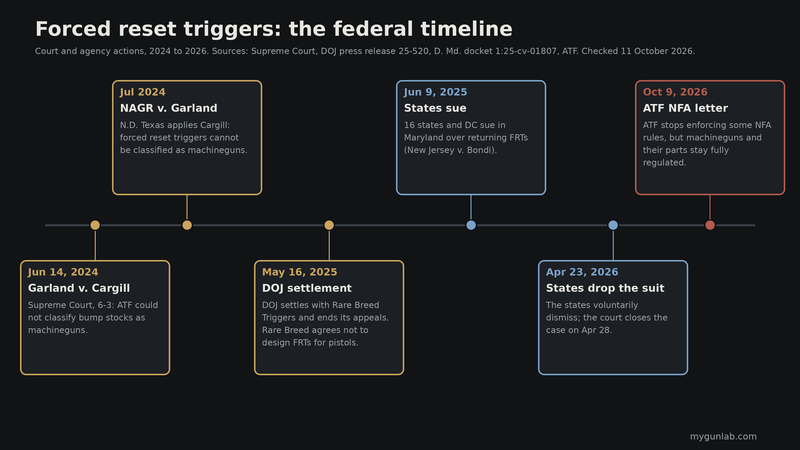
The federal timeline
| Date | What happened |
|---|---|
| June 14, 2024 | Garland v. Cargill (Supreme Court, 6-3): ATF cannot classify bump stocks as machineguns. |
| July 2024 | N.D. Texas, NAGR v. Garland: applying Cargill, forced reset triggers cannot be classified as machineguns. |
| May 16, 2025 | DOJ announces a settlement with Rare Breed Triggers (press release 25-520) that resolves its lawsuits and appeals. Rare Breed agrees not to design FRTs for pistols and to enforce its patents. |
| June 9, 2025 | 16 states and the District of Columbia sue in Maryland (State of New Jersey v. Bondi) over the federal approach to FRTs. |
| April 23, 2026 | The states voluntarily dismiss that lawsuit; the court closes the case on April 28. |
| October 9, 2026 | ATF stops enforcing some NFA rules for short-barreled rifles and suppressors. Machineguns stay fully regulated. |
Sources: Department of Justice press release, May 16, 2025; Garland v. Cargill; the Maryland docket on CourtListener.
FRT, binary trigger, bump stock and machinegun compared
| Standard trigger | Binary trigger | Forced reset trigger | Bump stock | Auto sear or "switch" | |
|---|---|---|---|---|---|
| Fires | One shot per pull | One on the pull, one on the release | One shot each time the trigger resets, with rearward pressure held | One shot per trigger movement, with the gun bumping against the finger | Many shots per pull |
| Federal status (Oct 2026) | Legal | No NFA paperwork; banned in some states | Not a machinegun per the 2024 ruling and the 2025 DOJ settlement | Not a machinegun: Cargill (2024) | A machinegun: unlawful to transfer or possess (18 U.S.C. 922(o)) unless lawfully possessed before 1986 |
| State law | Varies | Banned in some states | Banned in some states | Banned in some states | Machineguns restricted or banned |
What still matters before you buy
- State law. Several states ban or restrict forced reset triggers, binary triggers or "trigger activators". A federal ruling does not override a state ban. Check your state and any city rules.
- Machinegun conversion devices are different. An auto sear, "switch" or other part that makes a rifle fire automatically is a machinegun under the NFA, and possessing or transferring one is a federal crime. The ruling and settlement concern forced reset triggers, not those parts.
- The settlement is about Rare Breed's products. The Texas ruling and DOJ release name Rare Breed's devices; another maker's design is not named in them.
- It can change. A court ruling and a settlement are not a statute. Future courts, future administrations or Congress can revisit the question, and ATF's 2026 policy shifts show how quickly guidance moves. Keep your purchase records.
- Prohibited persons may not possess firearms.
Forced reset triggers and selectors we track
Two kinds of product use the forced reset idea. A drop-in forced reset trigger replaces the trigger group. A forced reset selector (or "forced reset safety") replaces the safety selector and works with a standard trigger group; AS Designs (ARC-Fire) and Atrius Development make them, and Atrius calls its selector an alternative to a forced reset trigger. The 2024 ruling and the 2025 settlement name Rare Breed's devices; the products below are other makers' designs, so read the state-law and federal notes above first. Prices from OpticsPlanet today:
None
None
None
None
Faster shooting without the legal gray area
A good two-stage or single-stage trigger gives a cleaner break and a quicker reset, with none of the questions above. Compare AR-15 triggers by price, read how an AR-15 trigger works and how to install one, or plan the rifle in the AR-15 builder. Four popular semi-automatic triggers, with today's prices:
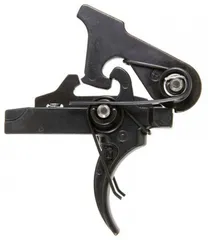
Geissele G2S two-stage
Pros
- Distinct wall and fast reset
- Widely used upgrade
Cons
- Costs more than a standard group
Two-stage
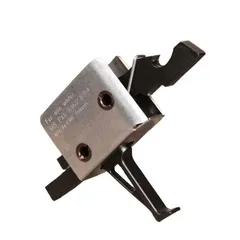
CMC single-stage drop-in
Pros
- Drop-in cartridge, easy install
- 3.5 lb flat trigger
Cons
- Single-stage: no wall
Single-stage drop-in
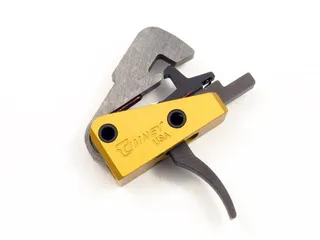
Timney single-stage competition
Pros
- Crisp 4 lb pull
- Self-contained housing
Cons
- Pricier than a mil-spec group
Single-stage
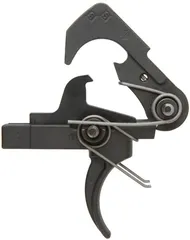
ALG Defense QMS mil-spec
Pros
- Mil-spec style, low price
- Smoother than stock parts
Cons
- Not a precision pull
Mil-spec style
Frequently asked questions
What is a forced reset trigger?
A semi-automatic AR-15 trigger that uses the gun's cycling to push the trigger forward after each shot, so it resets without you releasing it.
Are forced reset triggers legal?
Federally, yes: in July 2024 a Texas federal court held they cannot be classified as machineguns, and the Justice Department settled with Rare Breed Triggers on May 16, 2025. Some states ban them, so check yours.
Is a forced reset trigger a machinegun?
Not under current federal law. The Supreme Court held in Cargill that firing more than one shot requires more than one function of the trigger, and the Texas court applied that to FRTs. Auto sears and "switches" are machineguns.
What did the Rare Breed settlement do?
It resolved the government's lawsuits and appeals over Rare Breed's triggers. Rare Breed agreed not to design FRTs for pistols and to enforce its patents.
How is an FRT different from a binary trigger?
A binary trigger fires once when you pull and again when you release. An FRT resets the trigger for you so you can fire again by keeping pressure on it.
Could the law change?
Yes. A court ruling and a settlement are not a statute, and states set their own rules.
Where can I buy a forced reset trigger?
From firearm parts retailers. We list drop-in forced reset triggers and forced reset selectors from OpticsPlanet with today's prices. Check your state's law first, because some states ban them and a retailer may not ship there.