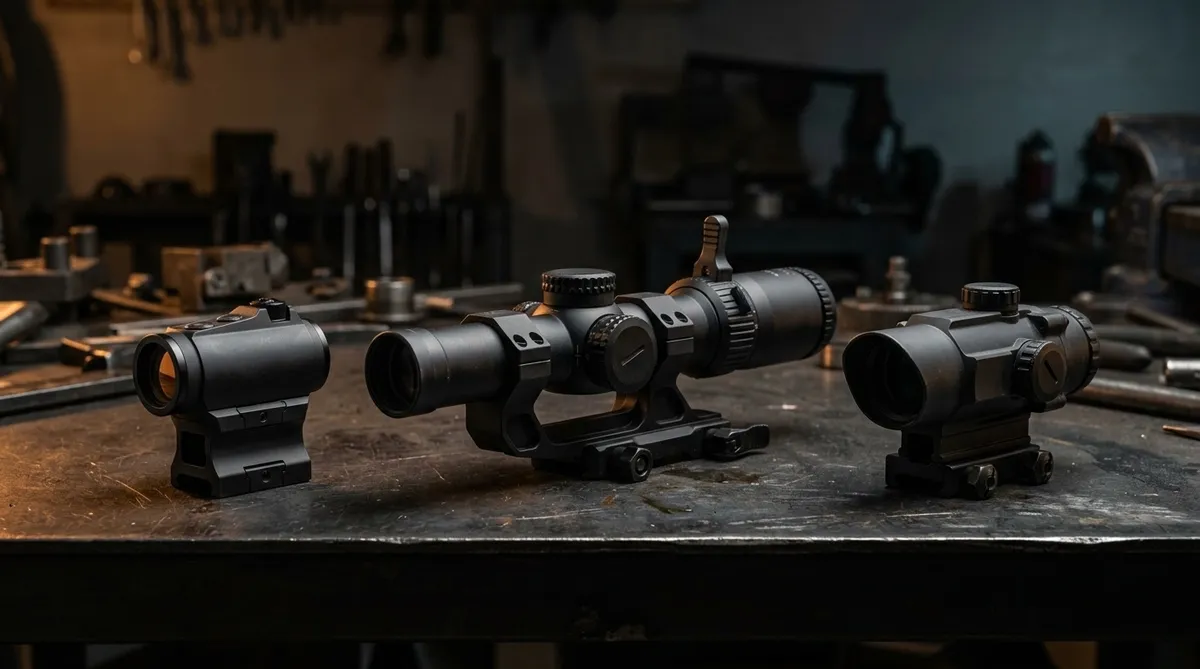
Short answer: a red dot is the fastest and lightest choice for close and medium range. A prism scope adds fixed magnification and an etched reticle that still works without a battery, and often suits shooters with astigmatism. An LPVO (low-power variable optic, usually 1-6x or 1-8x) does both close range and distance, at more weight and cost.
How they compare
| Red dot | Prism scope | LPVO | |
|---|---|---|---|
| Magnification | None (1x) | Fixed: 1x to 5x | Variable: 1-4x up to 1-10x |
| Speed up close | Fastest | Fast at 1x, slower above | Fast at 1x |
| Range | Close to medium | Medium | Close to long |
| Eye relief | Unlimited | Short and fixed | Moderate, tighter at high power |
| Without a battery | No dot | Etched reticle still works | Most have an etched reticle |
| Astigmatism | Dot can look blurry | Often better | Often better |
| Weight | Lightest | Medium | Heaviest |
| Mount | Riser to co-witness height | Usually included | Cantilever mount |
Which should you pick?
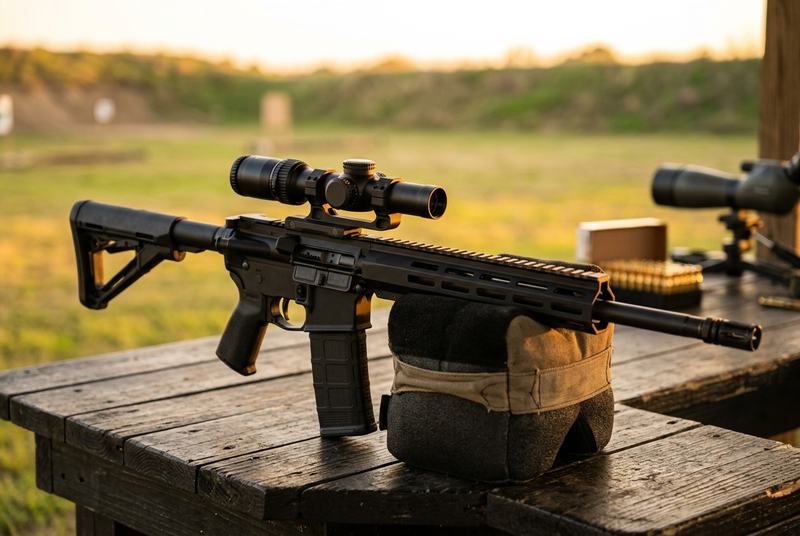
- Home defense and fast shooting inside 100 yards: a red dot. Add a magnifier later if you want reach.
- Astigmatism, or you want a reticle that never dies: a 1x to 3x prism.
- One rifle for everything, including 300 yards and beyond: an LPVO. A first focal plane LPVO keeps holdovers correct at every magnification; a second focal plane one keeps the reticle bold at 1x.
Compare AR-15 optics and optic mounts by price, see our best AR-15 red dot sights, and add your pick to the AR-15 builder.
Whichever optic you pick, see the best flip-up backup sights, including offset sights for magnified optics.
For how a red dot works and what 2 MOA means, see what is a red dot sight.
Frequently asked questions
Is a red dot or an LPVO better for an AR-15?
A red dot is faster and lighter for close and medium range; an LPVO covers longer distances too. Choose by how far you'll actually shoot.
Are prism scopes good for astigmatism?
Often, yes: the reticle is etched glass rather than a projected dot, so it usually looks sharper to shooters with astigmatism.
What mount does an LPVO need?
A one-piece cantilever mount that pushes the scope forward for correct eye relief, at a height of about 1.54 to 1.7 inches on a flat-top AR-15.
Can I add magnification to a red dot?
Yes, with a flip-to-side magnifier behind the dot, usually 3x to 6x. It adds weight and cost, but keeps the dot for close range.