Short answer: the forward assist is the round button on the right side of an AR-15 upper, behind the ejection port. Pressing it pushes the bolt carrier forward the last fraction of an inch, so the bolt locks when the action stops just short of closing. Most shooters rarely need it, and many builds skip it entirely with a slick-side upper.
How the forward assist works
The button sits on a spring-loaded plunger with a small claw (the pawl) on its tip. When you press it, the pawl catches the row of notches cut into the right side of the bolt carrier and shoves the carrier forward. That only works if your carrier has those notches. Most mil-spec bolt carriers do; some lightweight and low-mass carriers don't, so check before pairing them with a forward assist upper.
The original AR-15 had no forward assist. The Army asked for one on the M16A1 in the 1960s, after reports of rifles failing to close in dirty conditions, and it has been standard on most uppers since.
When to use it (and when not to)
- Quiet chambering: ease the charging handle forward to avoid the noise of the bolt slamming home, then tap the forward assist to finish closing it. This is the most common use today.
- After a press check: if you pull the charging handle back slightly to see a round in the chamber, a tap on the forward assist makes sure the bolt is fully locked again.
- Don't force a stuck round. If the bolt won't close on its own, something is usually wrong: a dirty chamber, a bad or oversized round, or debris. Ramming it closed can make the jam worse. Clear the malfunction, look at the round, and fix the cause.
Forward assist vs slick-side upper
| With forward assist | Slick side (no forward assist) | |
|---|---|---|
| What it is | Button and plunger behind the ejection port | Smooth right side, no button or housing |
| Weight | Standard | Slightly lighter (a few ounces with the parts left out) |
| Cost | Standard | Often a little cheaper, fewer parts to install |
| Quiet chambering | Easy: ride the handle forward, tap the assist | Push the charging handle or carrier by hand |
| Bolt carrier | Needs a carrier with forward-assist notches | Any carrier |
| Typical use | Duty-style and general-purpose rifles | Lightweight, retro (A1) and minimalist builds |
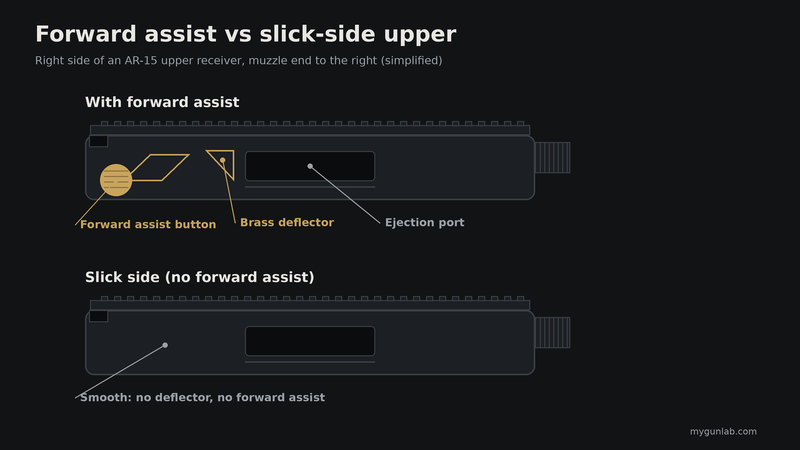
Do you need a forward assist?
For most people, no, but it doesn't hurt to have one. A well-maintained rifle with good ammo almost always closes on its own. The forward assist is a nice-to-have for quiet chambering and press checks, and most standard uppers include it anyway. If you're building light or want a cleaner look, a slick-side upper gives up very little. Just be consistent: a slick-side upper doesn't need a forward assist kit, and a forward-assist upper needs the assembly installed (button, spring and roll pin) or a blanking plug.
Shopping for uppers? Compare AR-15 upper receivers by price, including slick-side models like the Luth-AR Slick Side A1 upper, and the upper parts you need to finish one. The AR-15 builder keeps the whole parts list together. Building from scratch? See how to build an AR-15.
Forward assist assemblies compared
Replacing a worn button or finishing a stripped upper? Today's prices across the stores we track:
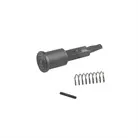
Luth-AR forward assist assembly
Pros
- Mil-spec, complete with spring and roll pin
- Cheapest option
Cons
- Plain standard button
The budget pick for a new upper.
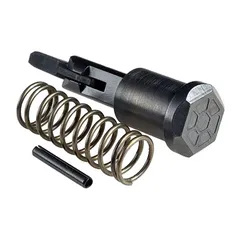
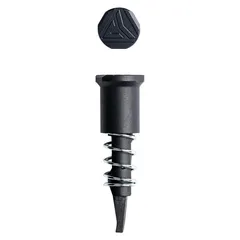
Strike Industries hex forward assist
Pros
- Hex-pattern button, easy to find by feel
- Sold at 8 stores
Cons
- Styling over function
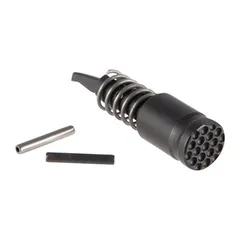
Forward Controls Design low-drag forward assist
Pros
- Low-profile button snags less on gear
- Steel, durable
Cons
- Costs more than a standard assist
For slings and plate carriers that rub the upper.
Radian forward assist
Pros
- Machined, sharp-looking upgrade
- Matches Radian charging handles
Cons
- Most expensive here
Not every bolt carrier has forward-assist notches. See our bolt carrier group guide for what to look for.
Frequently asked questions
What is the forward assist on an AR-15?
A spring-loaded button on the right side of the upper receiver. Pressing it pushes the bolt carrier forward so the bolt fully locks.
Is a forward assist necessary?
No. A clean rifle with good ammunition closes on its own almost every time. It's handy for quiet chambering and press checks, but many shooters never use it.
What is a slick-side upper?
An AR-15 upper receiver without a forward assist (and often without a brass deflector), leaving a smooth right side. It's slightly lighter and simpler.
Can I use any bolt carrier with a forward assist upper?
The rifle will run, but the forward assist only works if the carrier has the notches on its right side. Most mil-spec carriers have them; some lightweight carriers don't.
Should I use the forward assist when a round won't chamber?
Usually not. If the bolt won't close by itself, clear the round and find the cause instead of forcing it.