Short answer: a "full-auto" bolt carrier group (BCG) is a carrier made to the military M16 profile. In a semi-auto AR-15 it works the same as a regular carrier and does not make the rifle fire automatically: that takes other parts (see the legal note below). Finish matters less than people argue about: phosphate is the cheap mil-spec standard, nitride and chrome wear and clean better, nickel boron is the slickest. A good bolt, a properly staked gas key and proper testing (MPI and HPT) count for more than any coating.
What is in an AR-15 bolt carrier group?
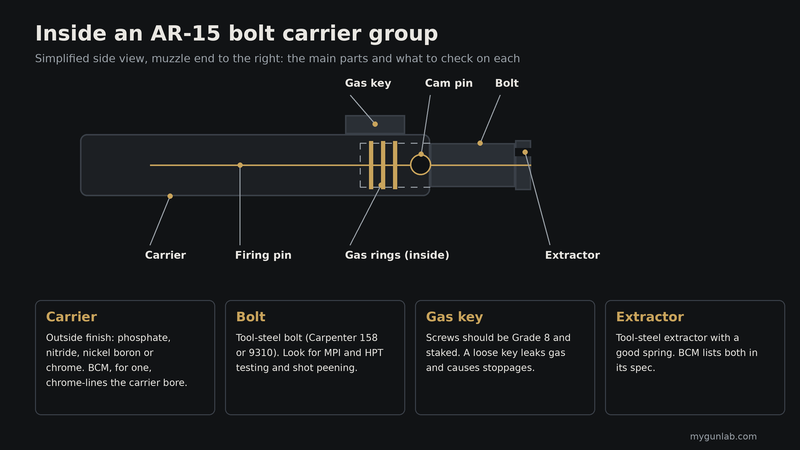
A BCG is five main parts. The bolt locks the cartridge in the chamber. The carrier rides back and forth in the upper and cycles the bolt. The gas key on top catches the gas from the gas tube and drives the carrier back. The cam pin turns the bolt to lock and unlock it, and the firing pin strikes the primer. Gas rings on the bolt seal against the carrier, and an extractor and ejector pull and kick out the empty case.
Full-auto vs semi-auto bolt carrier
An M16 (full-auto) carrier is the military pattern. Its rear underside is shaped to work with the auto sear in a machine gun. A semi-auto carrier is made without that feature. Everything else you care about is the same: both run the same bolt, gas key and firing pin, and both carry the notches a forward assist needs on most mil-spec versions. Many makers sell the M16 pattern as their top-quality version, which is a large part of why people ask for "full auto" BCGs. In a semi-auto rifle it gives you no extra speed or reliability by itself.
Is a full-auto BCG legal in an AR-15?
Federal law defines a machine gun in 26 U.S.C. 5845(b) as a weapon that fires automatically, its frame or receiver, any part "designed and intended solely and exclusively" for converting a weapon, and any combination of parts from which a machine gun can be assembled. A bolt carrier on its own is generally not treated as one: BCM's product page quotes ATF as saying it is not unlawful to use an M16 bolt carrier in a semi-automatic AR-15 type rifle. What does make a rifle a machine gun is the fire-control side: an auto sear is a machine gun by itself, and M16 fire-control parts kept together with an M16 carrier can be treated as a combination of parts. ATF's letters on this have not always read the same, and some states are stricter than federal law, so check current ATF guidance and your state's law first. Checked 11 October 2026. This is general information, not legal advice.
Which should you buy?
For a semi-auto AR-15, either. Buy the M16-pattern carrier if the maker's version is the better built or cheaper; buy the semi-auto version otherwise. Prices do not follow the label: Failzero's full-auto BCG costs less than its semi-auto, while LMT charges more for the full-auto.
Finish compared: phosphate, nitride, chrome, nickel boron
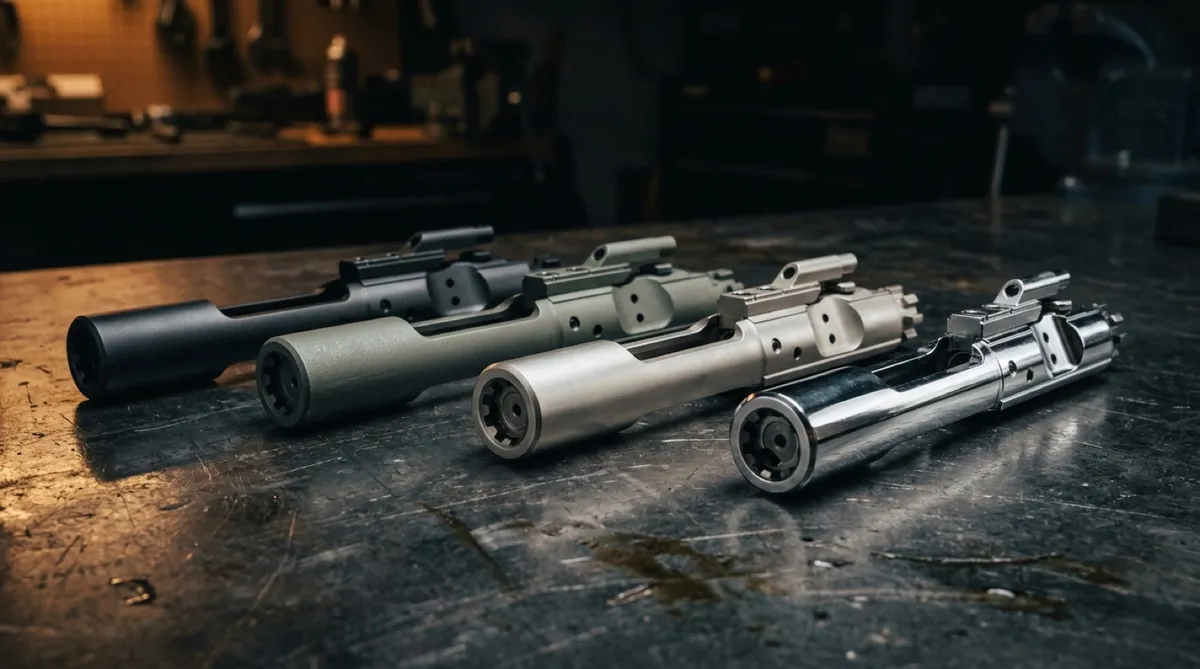
The finish protects the steel from rust and wear and changes how easily the group cleans. Prices below are what we see for 5.56 bolt carrier groups with that finish, 11 October 2026.
| Phosphate | Nitride | Chrome | Nickel boron | |
|---|---|---|---|---|
| What it is | Parkerized (manganese phosphate) surface, the mil-spec outer finish | Hardened surface made in a salt bath (often sold as Melonite or QPQ) | Hard chrome plating, used on the carrier bore and gas key and sometimes outside | Nickel-boron plating |
| Look | Matte dark grey to black | Black, smooth | Bright silver | Silver-grey |
| Wear and rust | Fine if oiled; wears to bare steel with hard use | Resists wear and rust well | Hard and rust resistant | Hard and rust resistant |
| Cleaning | Holds oil and carbon; takes more scrubbing | Cleans easier than phosphate | Wipes clean | Slickest and easiest to wipe clean |
| Price today | About $100-$182 | About $94-$210; coloured PVD versions $149-$225 | About $117-$205 (few in stock) | About $110-$250 |
| Best for | Budget builds, mil-spec fans | Most builds | Hard use, easy cleaning | Wet or dirty conditions, minimal cleaning |
PVD, DLC and "chameleon" coatings sit on top of a nitride base. They add colour and some hardness and cost more; none of them changes how the rifle cycles. If your carrier stays dry and you do not mind cleaning it, phosphate is enough.
What matters more than the finish
Cheap and expensive groups can share a coating but differ where it counts. Look for:
- Bolt steel and testing: BCM, for example, machines the bolt from Carpenter 158 steel, shot peens it, and HPT and MPI tests it (high-pressure test and magnetic particle inspection).
- A staked gas key: the key should be held by Grade 8 screws and staked so it cannot back out. A loose key leaks gas and causes stoppages.
- Tool-steel extractor and ejector with a good extractor spring.
- A chrome-lined carrier bore and key: BCM does both, with a parkerized outside.
- The right bolt face: a 5.56 group fits 5.56 and 300 Blackout (see our 300 Blackout BCG guide); 6.5 Grendel needs its own bolt (Grendel bolt guide), and AR-10 groups are a different size (AR-10 vs AR-15 parts).
Live picks: one of each finish
Today's lowest prices across the stores we track, all 5.56/.223:
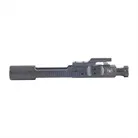
Spikes Tactical phosphate BCG
Pros
- Classic mil-spec phosphate finish
- Good price
Cons
- Takes more cleaning than nitride
Phosphate
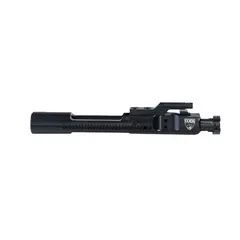
Faxon mil-spec nitride BCG
Pros
- Black nitride, mil-spec
- Best value nitride we track
Cons
- Plain black, no extras
Nitride
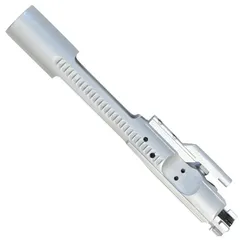
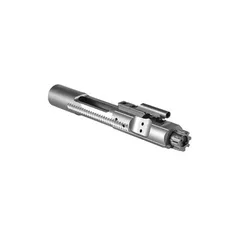
KAK M16 full chrome BCG
Pros
- Chrome finish, M16 pattern
- Low price for chrome
Cons
- Shiny: not for low-glare builds
Chrome (M16 pattern)
Brownells MPI nickel boron BCG
Pros
- Nickel boron, MPI tested
- Easy to wipe clean
Cons
- Costs more than phosphate
Nickel boron
Same maker, both versions
LMT and Failzero each sell both patterns, so you can see the price gap yourself:
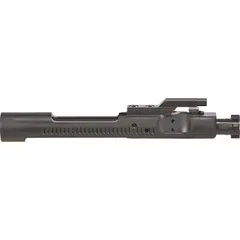
LMT semi-auto BCG
Pros
- Semi-auto pattern
- LMT build quality
Cons
- Costs more than most
Semi-auto
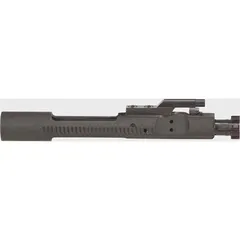
LMT full-auto BCG
Pros
- M16 pattern
- Same maker as the semi
Cons
- Pricier again
Full-auto (M16)
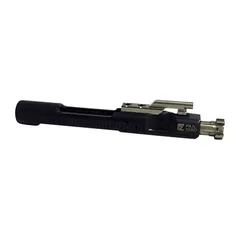
Failzero semi-auto BCG
Pros
- Semi-auto pattern
- Lower price than LMT
Cons
- Costs more than Failzero's own full-auto
Semi-auto
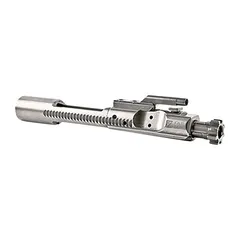
Failzero full-auto BCG
Pros
- M16 pattern
- Cheaper than the semi-auto
Cons
- Plain finish
Full-auto (M16)
Which BCG is right for your build?
- Budget AR-15: a phosphate or nitride mil-spec group.
- Everyday and home defense: nitride or chrome, from a maker that MPI/HPT tests.
- Heavy shooting or dirty conditions: nickel boron or chrome.
- Short barrel, suppressor or buffer changes: your buffer weight matters more than the BCG, see AR-15 buffer weights.
Compare bolt carrier groups by price, then add one to your build in the AR-15 builder, which checks it against your upper. Related: best charging handles, which share the carrier's travel, and AR-15 vs M4.
Frequently asked questions
What is a full-auto BCG?
A bolt carrier group made to the military M16 pattern. The carrier is shaped to work with an auto sear, which a semi-auto AR-15 does not have.
Will a full-auto BCG make my AR-15 fully automatic?
No. A semi-auto lower fires one shot per pull whichever carrier is fitted. Automatic fire needs regulated fire-control parts, such as an auto sear.
Is a full-auto BCG legal in a semi-auto AR-15?
The carrier alone is generally treated as legal: BCM's page quotes ATF saying it is not unlawful. M16 fire-control parts are a different matter. ATF letters have not always been consistent and some states are stricter, so check before you buy.
Is nitride better than phosphate?
Nitride resists wear and rust better and cleans more easily. Phosphate is the cheaper mil-spec standard and works fine if it stays oiled.
Is a chrome BCG worth it?
Chrome is hard, slick and rust resistant. Most makers already chrome-line the carrier bore and gas key, so a fully chrome group mainly adds a finish that is easy to wipe down.
Do I need a different BCG for 300 Blackout?
No, a standard 5.56 group works. 6.5 Grendel needs its own bolt.