Short answer: a supersonic 300 Blackout load leaves a 16-inch barrel at about 2,375 fps with a 110 grain bullet (Hornady) or about 1,900 fps with a 150 grain bullet (Federal), and still carries roughly 580-820 ft-lb at 200-300 yards. A subsonic 208 grain load leaves at about 1,020 fps with 480 ft-lb, drops about 34 inches at 200 yards from a 100-yard zero, and stays under the speed of sound (about 1,116 fps at 59°F) the whole way. Below is the makers' own data for four loads, with the test barrel length named wherever the maker gives it.
Data read from Hornady's and Federal's own product pages on 11 October 2026. Real velocity changes with barrel length, lot and temperature, so treat these as published figures, not guarantees.
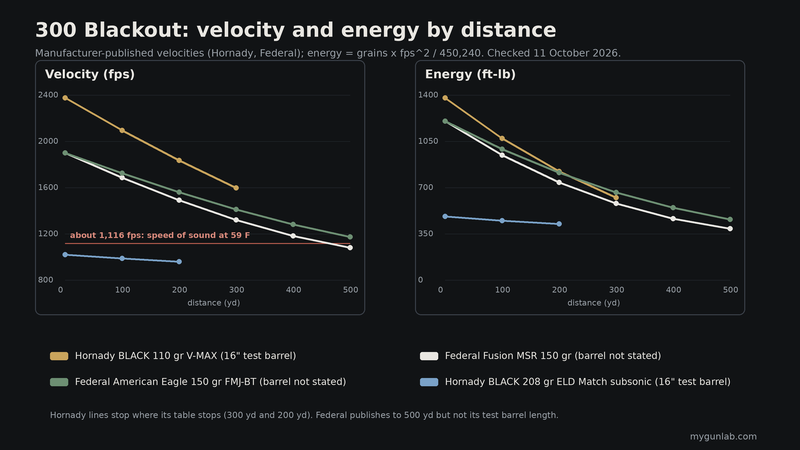
300 Blackout ballistics chart
Hornady BLACK: 110 gr supersonic vs 208 gr subsonic (16-inch test barrel)
Hornady publishes velocity, energy and drop for both loads from a 16-inch test barrel. Drop is in inches relative to the line of sight; the 0.0 row is the zero distance, and the muzzle figure reflects the sight height above the bore.
| Distance | 110 gr V-MAX: velocity (fps) | energy (ft-lb) | drop (in), 200 yd zero | 208 gr ELD Match subsonic: velocity (fps) | energy (ft-lb) | drop (in), 100 yd zero |
|---|---|---|---|---|---|---|
| Muzzle | 2,375 | 1,378 | -1.5 | 1,020 | 480 | -1.5 |
| 100 yd | 2,094 | 1,071 | +3.2 | 987 | 450 | 0.0 |
| 200 yd | 1,834 | 821 | 0.0 | 959 | 424 | -33.5 |
| 300 yd | 1,597 | 623 | -13.7 |
Hornady's page lists these rows without distance headings in the text we read; we read them as 100-yard steps (muzzle, 100, 200, 300 yd), which matches the velocity loss and the zero implied by each table. Check the box or Hornady's page if you need to be sure.
Federal: 150 gr Fusion MSR and American Eagle out to 500 yards
Federal lists velocity to 500 yards for two 150 grain loads, both at 1,900 fps at the muzzle. Federal does not state the test barrel length on these pages (it says Fusion MSR is built for short barrels). Energy below is calculated from the published velocity (grains × fps² ÷ 450,240), which matches Federal's own muzzle figure to within a foot-pound.
| Distance | Fusion MSR 150 gr SP: velocity (fps) | energy (ft-lb) | American Eagle 150 gr FMJ-BT: velocity (fps) | energy (ft-lb) |
|---|---|---|---|---|
| Muzzle | 1,900 | 1,203 | 1,900 | 1,203 |
| 100 yd | 1,685 | 946 | 1,724 | 990 |
| 200 yd | 1,490 | 740 | 1,561 | 812 |
| 300 yd | 1,320 | 580 | 1,411 | 663 |
| 400 yd | 1,181 | 465 | 1,282 | 548 |
| 500 yd | 1,079 | 388 | 1,174 | 459 |
Supersonic vs subsonic: what the numbers show
- Energy. The 208 grain subsonic carries 480 ft-lb at the muzzle, about a third of the 110 grain supersonic (1,378 ft-lb). It starts slow and slows little: it loses 61 fps in 200 yards, against more than 500 fps for the supersonic load.
- Drop. That low speed costs drop. With a 100-yard zero, Hornady shows the subsonic 33.5 inches low at 200 yards. The 110 grain with a 200-yard zero is 13.7 inches low at 300 yards.
- The speed of sound. Subsonic means below roughly 1,116 fps at 59°F (a little more when it is warmer). On Federal's numbers the 150 grain Fusion MSR is still supersonic at 400 yards (1,181 fps) and falls below the speed of sound before 500 yards (1,079 fps); the American Eagle stays above it (1,174 fps).
- Heavier bullets hold energy. The 150 grain American Eagle starts with less energy than the 110 grain V-MAX (1,203 vs 1,378 ft-lb) but keeps more at 300 yards (663 vs 623 ft-lb) on these published figures. They come from different makers and an unstated barrel, so use it as a guide.
Subsonic or supersonic?
Supersonic loads are flatter and carry more energy, so they suit general use and any rifle without a suppressor. Subsonic loads are for suppressed rifles, where staying under the speed of sound removes the bullet's crack. They are slow, so expect a big drop past 100 yards and zero them closer. Our 300 Blackout BCG and magazine guide covers the rest of the rifle.
Barrel length changes these numbers
Hornady's figures are for a 16-inch barrel. A shorter barrel gives lower velocity, and every maker tests at its own length, so compare loads with the barrel length in mind. Compare 300 Blackout barrels by length, or see how it fits in the AR-15 caliber comparison.
The four loads, with today's prices
Lowest price across the stores we track, 20 rounds each:
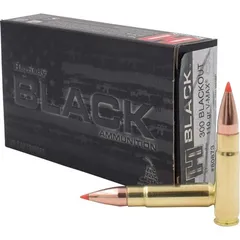
Hornady BLACK 110 gr V-MAX
Pros
- 2,375 fps from a 16" test barrel
- Flat for a 300 BLK
Cons
- Lighter bullet loses energy faster
Supersonic, 110 gr
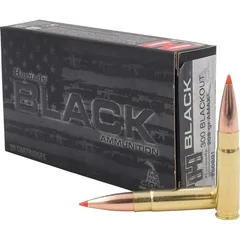
Hornady BLACK 208 gr ELD Match
Pros
- About 1,020 fps: stays subsonic
- High-BC match bullet
Cons
- Big drop past 100 yd
Subsonic, 208 gr
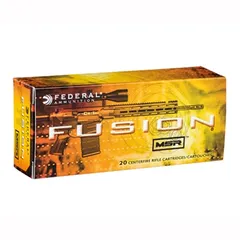
Federal Fusion MSR 150 gr SP
Pros
- Soft point built for short barrels
- Published to 500 yd
Cons
- Federal does not state test barrel
Supersonic, 150 gr
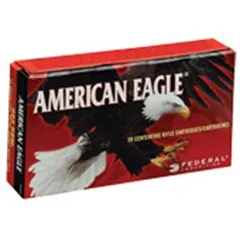
Federal American Eagle 150 gr FMJ
Pros
- Range-grade price
- Keeps energy well to 500 yd
Cons
- FMJ: target use
Supersonic, 150 gr FMJ-BT
More 300 Blackout ammo is in our ammo category, and our ammo cost per round data compares 300 Blackout with other calibers. Planning a build? Start in the AR-15 builder.
Comparing calibers? See the 5.56 ballistics chart too.
Frequently asked questions
How fast is 300 Blackout?
Supersonic loads are published at about 1,900 fps (150 grain, Federal) to 2,375 fps (110 grain, Hornady, 16-inch test barrel). Subsonic loads run about 1,000 fps.
How far does 300 Blackout drop at 100 and 200 yards?
Hornady's 110 grain V-MAX zeroed at 200 yards is +3.2 inches at 100 yards and 0.0 at 200 yards. Its 208 grain subsonic with a 100-yard zero is 33.5 inches low at 200 yards.
Is 300 Blackout subsonic?
Only the heavy subsonic loads (about 200-220 grain, around 1,000 fps). Standard 110-150 grain loads are supersonic. Subsonic means below about 1,116 fps at 59°F.
How much energy does 300 Blackout have?
About 1,200-1,380 ft-lb at the muzzle for the supersonic loads here, falling to about 620-820 ft-lb at 200-300 yards, and 480 ft-lb for the 208 grain subsonic.
What barrel length do these numbers use?
Hornady tests in a 16-inch barrel. Federal does not state the barrel length for its listed tables.
Which 300 Blackout load is flattest?
Of the four here, the 110 grain V-MAX: it is fastest, with +3.2 inches at 100 yards and 13.7 inches low at 300 yards from a 200-yard zero.