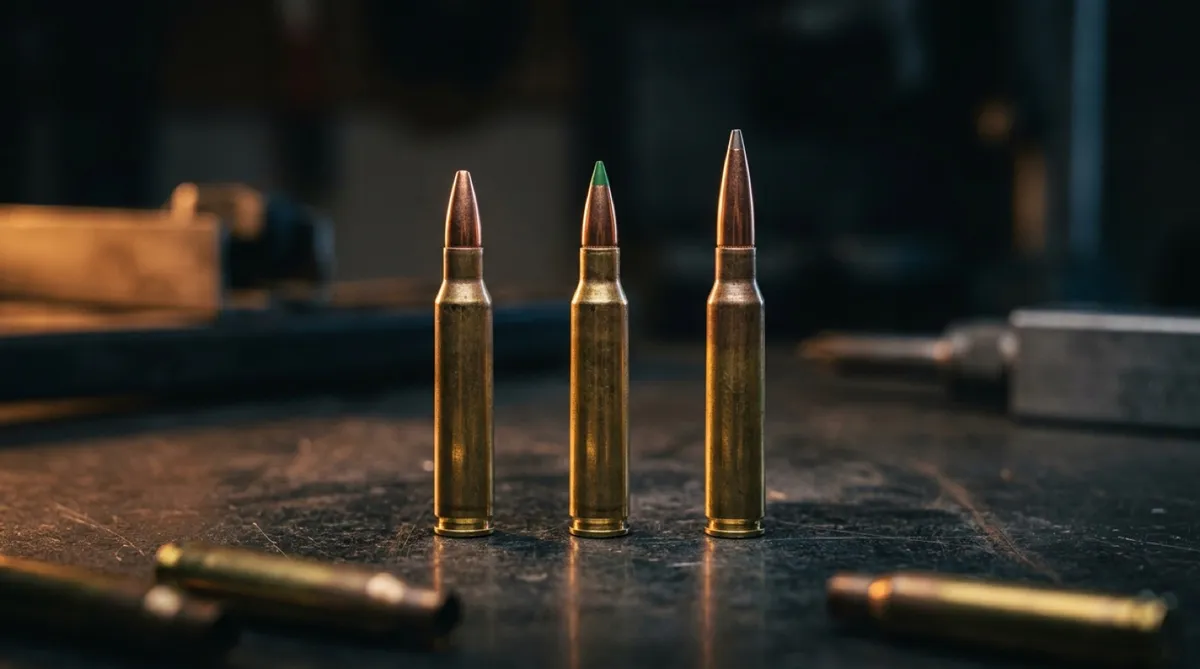
Short answer: from a 20-inch test barrel, Hornady publishes 3,240 fps for a 55 grain FMJ, 3,060 fps for a 62 grain and 2,910 fps for a 75 grain match bullet; Black Hills lists 2,750 fps for 77 grain. The light bullets are fastest at the muzzle but the heavy ones win further out: at 500 yards the 75 grain still has 1,851 fps and 570 ft-lb, against 1,540 fps and 290 ft-lb for the 55 grain. A 16-inch barrel is slower: one independent test measured 92 fps less than a 20-inch barrel with the same 77 grain load (2,730 vs 2,822 fps). Below are the makers' own tables.
Data read from Hornady's and Black Hills' own pages on 11 October 2026. Real velocity changes with barrel length, lot and temperature, so treat these as published figures.
5.56 ballistics chart
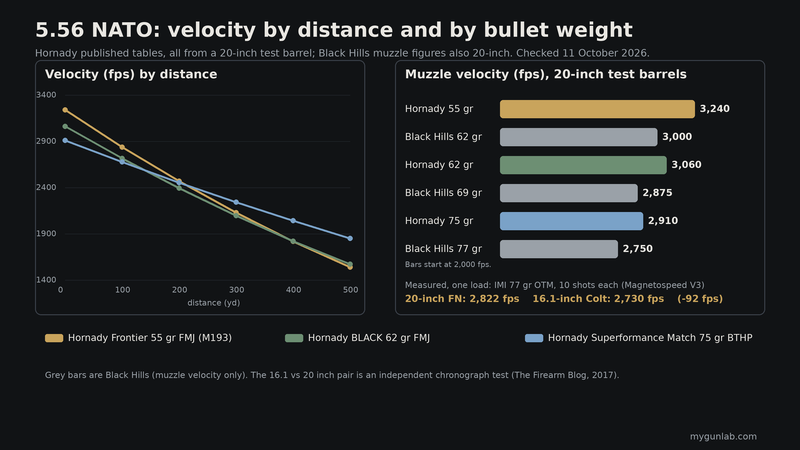
Velocity and energy: 55 vs 62 vs 75 grain (20-inch test barrel)
All three Hornady loads were tested in a 20-inch barrel. Hornady's page lists the rows without distance headings in the text we read; we read them as 100-yard steps from the muzzle to 500 yards, which matches the velocity loss and the zero in each table.
| Distance | 55 gr FMJ (M193): fps | ft-lb | 62 gr FMJ BLACK: fps | ft-lb | 75 gr BTHP: fps | ft-lb |
|---|---|---|---|---|---|---|
| Muzzle | 3,240 | 1,282 | 3,060 | 1,289 | 2,910 | 1,410 |
| 100 yd | 2,837 | 983 | 2,714 | 1,014 | 2,676 | 1,192 |
| 200 yd | 2,468 | 744 | 2,394 | 789 | 2,453 | 1,002 |
| 300 yd | 2,128 | 553 | 2,095 | 604 | 2,242 | 837 |
| 400 yd | 1,817 | 403 | 1,820 | 456 | 2,041 | 693 |
| 500 yd | 1,540 | 290 | 1,571 | 340 | 1,851 | 570 |
Bullet drop: 62 vs 75 grain
Hornady publishes drop for the 62 and 75 grain loads (not the 55 grain Frontier). Figures are inches above (+) or below (-) the line of sight with the rifle zeroed at 200 yards, so the muzzle figure is the sight height Hornady used.
| Distance | 62 gr FMJ BLACK: drop (in) | 75 gr BTHP: drop (in) |
|---|---|---|
| Muzzle | -1.5 | -2.4 |
| 100 yd | +1.6 | +1.2 |
| 200 yd | 0.0 | 0.0 |
| 300 yd | -7.7 | -7.0 |
| 400 yd | -23.4 | -21.0 |
| 500 yd | -49.7 | -43.3 |
What the numbers show
- Light bullets lose speed fastest. The 55 grain starts 330 fps faster than the 75 grain but the two are level at about 200 yards (2,468 vs 2,453 fps). By 300 yards the 75 grain is 114 fps faster, and at 500 yards it has almost twice the energy (570 vs 290 ft-lb).
- 62 grain sits between. It catches the 55 grain by 400 yards (1,820 vs 1,817 fps) and drops 49.7 inches at 500 yards against 43.3 for the 75 grain, 6.4 inches more.
- Heavier bullets need a faster twist. A 1:7 or 1:8 barrel handles 55 to 77 grain; 1:9 suits up to about 69 grain. See our barrel profile and twist rate guide before buying 77 grain.
77 grain: Black Hills figures
Black Hills lists its velocities from 20-inch barrels, muzzle only. Its numbers show the same pattern: lighter is faster and heavier carries more energy.
| Black Hills 5.56 load (20-inch barrel) | Muzzle velocity (fps) | Muzzle energy (ft-lb) |
|---|---|---|
| 50 gr Barnes TSX | 3,275 | 1,191 |
| 62 gr Dual Performance | 3,000 | 1,239 |
| 69 gr Open Tip Match | 2,875 | 1,266 |
| 77 gr Open Tip Match / Sierra TMK | 2,750 | 1,293 |
16-inch vs 20-inch barrel
No maker we checked publishes a 16-inch table for 5.56, so the tables above are all 20-inch figures. The best data we found is an independent test, not a maker table: The Firearm Blog (December 2017) fired IMI 77 grain Razor Core, a Mk 262 style load, through a 20-inch FN barrel (average 2,822 fps) and a 16.1-inch Colt barrel (average 2,730 fps), 10 shots each on a Magnetospeed V3. That is 92 fps (about 3%) slower from the shorter barrel and, calculated the same way as above, about 1,275 vs 1,362 ft-lb at the muzzle (around 6% less energy). One load and one pair of barrels is only a rough guide: expect something in that range, not an exact figure. Barrel and gas choices for a 16-inch rifle are in our gas system length chart.
The four loads, with today's prices
Lowest price across the stores we track:
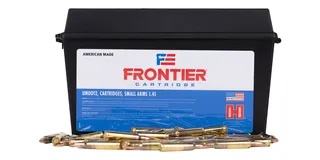
Hornady Frontier 55 gr FMJ (M193), 150 rd can
Pros
- 3,240 fps from a 20" test barrel
- Lowest cost per round of the four
Cons
- Loses speed fastest past 200 yd
55 grain
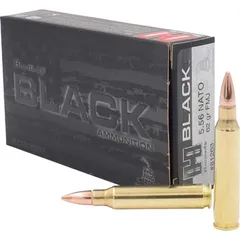
Hornady BLACK 62 gr FMJ
Pros
- 3,060 fps, 20" test barrel
- Hornady publishes its drop
Cons
- FMJ: target and plinking
62 grain
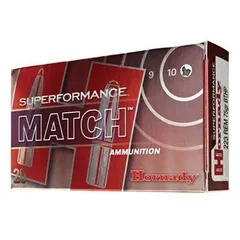
Hornady Superformance Match 75 gr BTHP
Pros
- Holds 1,851 fps at 500 yd
- Best 500 yd energy of these loads
Cons
- Needs a faster twist
75 grain
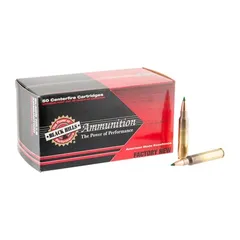
Black Hills 77 gr Sierra TMK, 50 rd
Pros
- Mk 262 style match bullet
- 2,750 fps from a 20" barrel
Cons
- Costs the most per round
77 grain
More 5.56 ammo is in our ammo category, and our ammo cost per round data compares 5.56 with other calibers. Choosing a barrel? Compare AR-15 barrels by length, or plan the whole rifle in the AR-15 builder. Looking at other calibers? See our 300 Blackout ballistics chart.
Stepping up to .308? See the .308 ballistics chart for the AR-10.
Frequently asked questions
How fast is a 5.56 round?
From a 20-inch test barrel, Hornady publishes 3,240 fps (55 grain), 3,060 fps (62 grain) and 2,910 fps (75 grain). Black Hills lists 2,750 fps for 77 grain.
How much does a 5.56 bullet drop at 300 and 500 yards?
With a 200-yard zero, Hornady's 62 grain drops 7.7 inches at 300 yards and 49.7 inches at 500 yards; the 75 grain drops 7.0 and 43.3 inches.
How much velocity does a 16-inch barrel lose compared with 20 inches?
No maker publishes it, but one independent test of a 77 grain load measured 92 fps less from a 16.1-inch barrel (2,730 vs 2,822 fps). Treat it as a rough guide.
Which 5.56 bullet weight is best at long range?
Of the published tables, the 75 grain: at 500 yards it keeps 1,851 fps and 570 ft-lb, against 1,571 fps and 340 ft-lb for the 62 grain and 1,540 fps and 290 ft-lb for the 55 grain.
What barrel length do these numbers use?
Hornady tested in a 20-inch barrel and Black Hills states 20-inch barrels for its 5.56 figures.
Do heavier 5.56 bullets need a faster twist?
Generally yes. A 1:7 or 1:8 twist handles 55 to 77 grain; 1:9 suits bullets up to about 69 grain and 1:12 only light ones, per our twist rate guide.