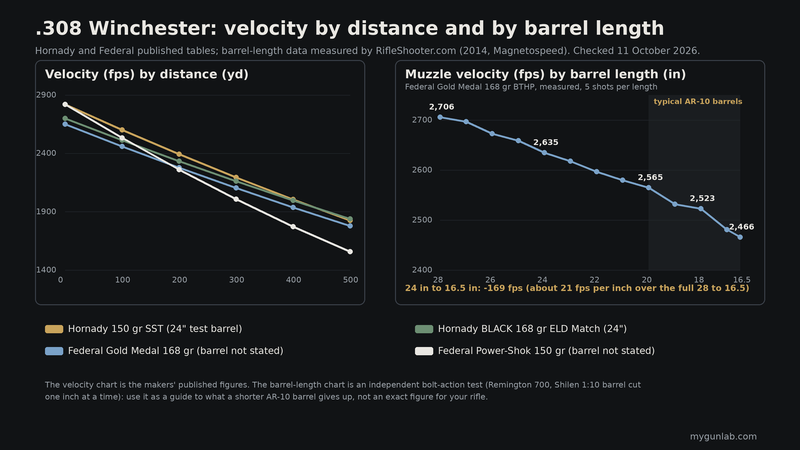
Short answer: from a 24-inch test barrel, Hornady publishes 2,820 fps for a 150 grain SST and 2,700 fps for a 168 grain ELD Match; Federal lists 2,820 fps (150 grain Power-Shok) and 2,650 fps (168 grain Gold Medal). At 500 yards the Hornady 168 grain still carries 1,839 fps and 1,261 ft-lb and has dropped 48.9 inches from a 200-yard zero. AR-10 barrels are usually 16 to 20 inches, shorter than the makers' test barrels: in one independent test a 168 grain load lost 169 fps going from 24 to 16.5 inches (2,635 to 2,466 fps), roughly 20 to 25 fps per inch.
Data read from Hornady's and Federal's own product pages and from a published chronograph test on 11 October 2026. Real velocity changes with barrel, lot and temperature, so treat these as published figures.
.308 ballistics chart
Hornady: 150 gr SST and 168 gr ELD Match (24-inch test barrel)
Hornady tests in a 24-inch barrel. Drop is inches above (+) or below (-) the line of sight with a 200-yard zero; the muzzle figure reflects the sight height. Hornady's page lists the rows without distance headings in the text we read; we read them as 100-yard steps from the muzzle to 500 yards, which matches the velocity loss and the zero.
| Distance | 150 gr SST: fps | ft-lb | drop (in) | 168 gr ELD Match (BLACK): fps | ft-lb | drop (in) |
|---|---|---|---|---|---|---|
| Muzzle | 2,820 | 2,649 | -1.5 | 2,700 | 2,719 | -1.5 |
| 100 yd | 2,601 | 2,253 | +1.8 | 2,513 | 2,355 | +2.0 |
| 200 yd | 2,393 | 1,907 | 0.0 | 2,333 | 2,030 | 0.0 |
| 300 yd | 2,194 | 1,603 | -7.9 | 2,161 | 1,742 | -8.4 |
| 400 yd | 2,005 | 1,338 | -23.1 | 1,996 | 1,486 | -24.3 |
| 500 yd | 1,826 | 1,110 | -46.9 | 1,839 | 1,261 | -48.9 |
Federal: 168 gr Gold Medal and 150 gr Power-Shok out to 500 yards
Federal publishes velocity to 500 yards but does not state the test barrel length on these pages; the Gold Medal's 2,650 fps is close to the 2,635 fps an independent test measured from a 24-inch barrel. Energy is calculated from the published velocity (grains × fps² ÷ 450,240), which reproduces Hornady's and Federal's own muzzle figures.
| Distance | Gold Medal 168 gr BTHP: fps | ft-lb | Power-Shok 150 gr SP: fps | ft-lb |
|---|---|---|---|---|
| Muzzle | 2,650 | 2,620 | 2,820 | 2,649 |
| 100 yd | 2,460 | 2,258 | 2,532 | 2,136 |
| 200 yd | 2,277 | 1,935 | 2,261 | 1,703 |
| 300 yd | 2,103 | 1,650 | 2,007 | 1,342 |
| 400 yd | 1,936 | 1,399 | 1,771 | 1,045 |
| 500 yd | 1,778 | 1,180 | 1,557 | 808 |
What the numbers show
- The heavier bullet catches up. Hornady's 150 grain starts 120 fps faster than its 168 grain but the two are level by 400 yards (2,005 vs 1,996 fps) and the 168 grain is ahead at 500 (1,839 vs 1,826 fps). It carries 14% more energy there (1,261 vs 1,110 ft-lb).
- Federal shows the same pattern, more strongly. The 168 grain Gold Medal is slower at the muzzle (2,650 vs 2,820 fps) but is faster than the 150 grain Power-Shok from 200 yards on, and at 500 yards it has 1,778 fps against 1,557 fps.
- Drop is nearly the same. From a 200-yard zero the two Hornady loads are within 2 inches of each other at 500 yards (46.9 vs 48.9 in).
- Against 5.56. Hornady's 62 grain 5.56 BLACK load has 1,571 fps and 340 ft-lb at 500 yards; the .308 168 grain has 1,261 ft-lb, almost four times the energy. See our 5.56 ballistics chart.
AR-10 barrel length: 16, 18 or 20 inches vs the 24-inch test barrel
Makers test .308 in 24-inch barrels, but most AR-10s have 16 to 20 inches. No maker publishes a table for those lengths, so here is the best independent data we found: RifleShooter.com's 2014 test, which cut a Remington 700 with a 1:10 Shilen barrel from 28 inches down to 16.5 inches one inch at a time, five shots per length on a Magnetospeed chronograph. It is a bolt action, not an AR-10, so use it as a guide.
| Barrel | Federal Gold Medal 168 gr BTHP | Winchester 147 gr FMJ | IMI Samson 150 gr FMJ | Winchester 180 gr Power-Point |
|---|---|---|---|---|
| 24 in | 2,635 | 2,909 | 2,766 | 2,553 |
| 20 in | 2,565 | 2,804 | 2,679 | 2,478 |
| 18 in | 2,523 | 2,739 | 2,595 | 2,411 |
| 16.5 in | 2,466 | 2,682 | 2,561 | 2,373 |
Going from 24 to 16.5 inches cost 169 to 227 fps depending on the load (the 168 grain lost 169). For the 168 grain Gold Medal that is about 2,591 ft-lb at 24 inches and 2,269 ft-lb at 16.5 inches, calculated the same way as above, around 12% less muzzle energy. Over the whole 28 to 16.5 inch range the loads averaged 21 to 25 fps per inch. For parts that fit a 16 to 20 inch AR-10 see our AR-10 vs AR-15 parts guide and AR-10 lower receivers.
The four loads, with today's prices
Lowest price across the stores we track, 20 rounds each:
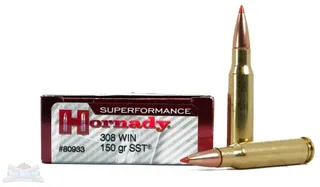
Hornady 150 gr SST
Pros
- 2,820 fps from a 24" test barrel
- Polymer-tipped hunting bullet
Cons
- Loses speed faster past 300 yd
150 grain
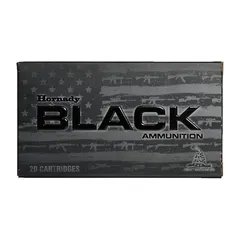
Hornady BLACK 168 gr ELD Match
Pros
- 1,261 ft-lb left at 500 yd
- Hornady publishes its drop to 500 yd
Cons
- Costs more than 150 gr hunting loads
168 grain
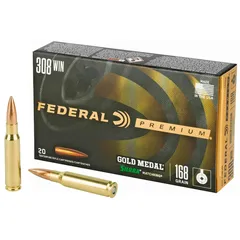
Federal Gold Medal 168 gr MatchKing
Pros
- Match bullet, BC .462
- Published to 500 yd
Cons
- Federal does not state the test barrel
168 grain
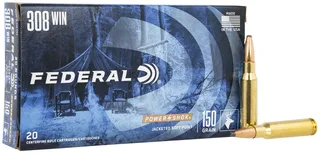
Federal Power-Shok 150 gr SP
Pros
- 2,820 fps published
- Lowest price here
Cons
- Retains less energy than the 168s at 500 yd
150 grain
More .308 ammo is in our ammo category, and our ammo cost per round data compares .308 with other calibers. Choosing a barrel? Compare AR barrels by length, or plan the rifle in the AR-15 builder. For the smaller calibers see our 5.56 and 300 Blackout charts.
Frequently asked questions
How fast is a .308 bullet?
From a 24-inch test barrel, Hornady publishes 2,820 fps (150 grain SST) and 2,700 fps (168 grain ELD Match). Federal lists 2,820 fps (150 grain) and 2,650 fps (168 grain).
How much does .308 drop at 300 and 500 yards?
With a 200-yard zero, Hornady's 168 grain drops 8.4 inches at 300 yards and 48.9 inches at 500 yards; the 150 grain drops 7.9 and 46.9 inches.
How much velocity does a 16-inch AR-10 barrel lose?
No maker publishes it. One independent test measured 169 fps less from a 16.5-inch barrel than a 24-inch barrel for a 168 grain Federal load (2,466 vs 2,635 fps), roughly 20 to 25 fps per inch.
How much energy does .308 have at 500 yards?
Hornady lists 1,261 ft-lb for its 168 grain and 1,110 ft-lb for its 150 grain at 500 yards from a 24-inch barrel.
How does .308 compare with 5.56 at 500 yards?
On Hornady's tables, a 168 grain .308 carries 1,261 ft-lb and a 62 grain 5.56 carries 340 ft-lb.
Which .308 weight is better for long range?
The 168 grain: it is slower at the muzzle but ends up faster and carries more energy by 500 yards than the 150 grain in both Hornady's and Federal's tables.