Short answer: most 5.56 and .223 AR-15 barrels are threaded 1/2x28. Most .30-caliber barrels, including 300 Blackout, 7.62x39 and .308 AR-10s, are 5/8x24. Big-bore .458 SOCOM and .450 Bushmaster barrels usually use 5/8x32. A few calibers vary by maker, so check your barrel's listing or markings before you order a muzzle device or suppressor.
Muzzle thread chart by caliber
| Caliber | Most common thread | Also seen | Notes |
|---|---|---|---|
| 5.56 NATO / .223 Rem | 1/2x28 | 5/8x24 | A few heavy or large-shank barrels use 5/8x24 |
| .224 Valkyrie | 1/2x28 | ||
| .22 LR (AR uppers) | 1/2x28 | ||
| 9mm (AR-9) | 1/2x28 | 1/2x36 | Some makers thread 9mm barrels 1/2x36 |
| 300 Blackout | 5/8x24 | Never fit a 5.56 muzzle device or suppressor | |
| 7.62x39 (AR) | 5/8x24 | AK rifles use M14x1 left-hand instead | |
| 6.5 Grendel | 5/8x24 | ||
| 6mm ARC | 5/8x24 | ||
| .350 Legend | 5/8x24 | ||
| 6.8 SPC | 5/8x24 | 1/2x36 | Varies by maker |
| .458 SOCOM | 5/8x32 | ||
| .450 Bushmaster | 5/8x32 | ||
| .308 / 7.62x51 (AR-10) | 5/8x24 | ||
| 6.5 Creedmoor (AR-10) | 5/8x24 | ||
| .45 ACP | .578x28 | Also written 37/64x28 | |
| 10mm | 9/16x24 | .578x28 | Varies by maker |
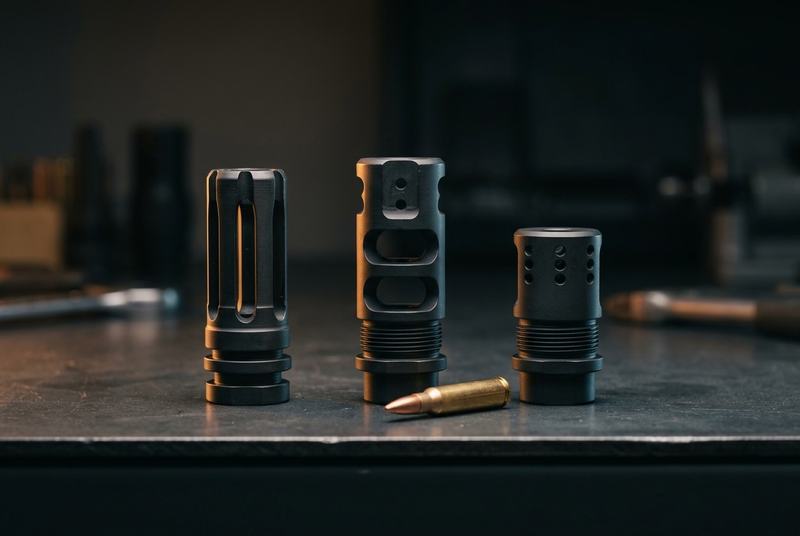
What the numbers mean
A thread like 1/2x28 gives the outside diameter of the threads in inches (1/2 inch) and the number of threads per inch (28). So 5/8x24 is a fatter thread with 24 threads per inch. A device made for one won't thread onto the other, and forcing it can ruin the barrel threads.
Why the bore matters more than the thread
The thread only tells you whether a device screws on. The hole through it matters just as much: a muzzle brake or suppressor made for .22-caliber bullets (5.56, .224 Valkyrie) is too small for a .30-caliber bullet. Putting a 5.56 device on a 300 Blackout barrel with a thread adapter can cause the bullet to strike it, which is dangerous. A .30-caliber device on a 5.56 barrel is safe, just less effective.
How to check your barrel
- Look at the barrel or its listing: most makers print or list the thread.
- Measure the outside of the threads with calipers: about 0.49 inch means 1/2-inch threads, about 0.62 inch means 5/8-inch threads.
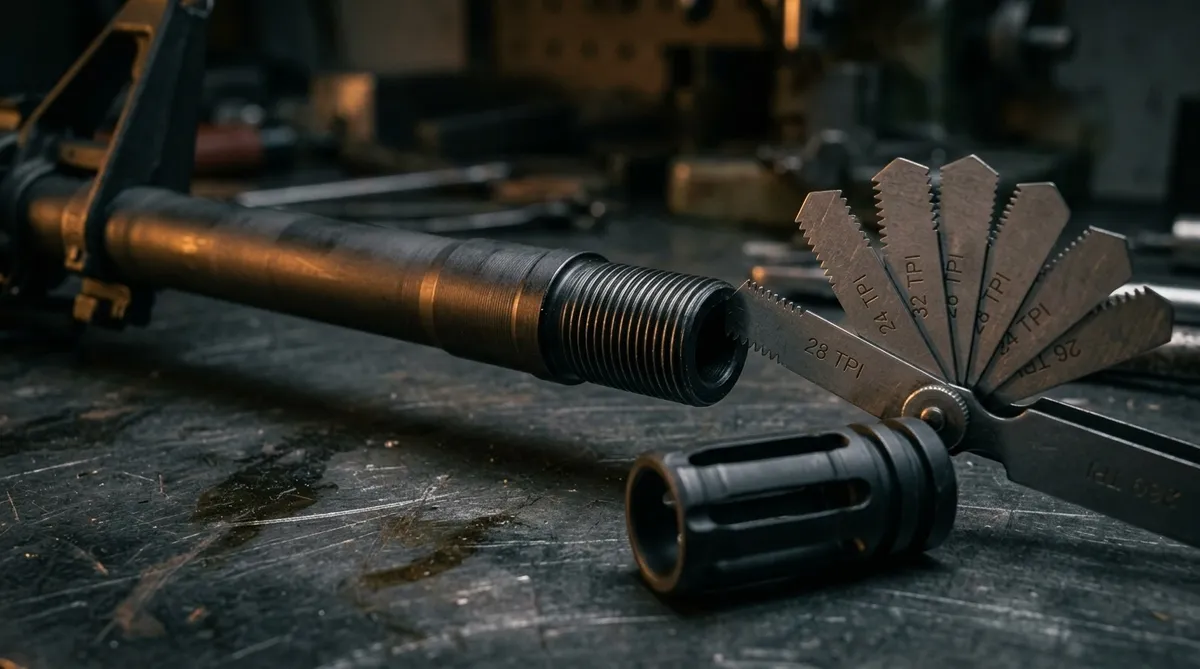
- Use a thread pitch gauge to count threads per inch (28, 24, 32 or 36).
- Ask the seller if you're not sure. Don't guess on a suppressor.
What our catalog shows
As of October 2026, of the 5.56 barrels in our catalog with a known thread, 75 of 78 are 1/2x28 and 3 are 5/8x24. All 13 300 Blackout barrels with a known thread are 5/8x24, as are all 9 in 6mm ARC and all 6 in 6.5 Grendel, and all 16 9mm barrels with a known thread are 1/2x28.
Shop by thread: 1/2x28 muzzle devices, 5/8x24 muzzle devices, 300 Blackout barrels and suppressors. When you add a barrel and a muzzle device to the AR-15 builder, it flags a thread mismatch whenever it knows both threads.
Frequently asked questions
Is every 5.56 AR-15 barrel threaded 1/2x28?
Almost all are. A few heavy or large-shank 5.56 barrels use 5/8x24, so check the listing before you buy a muzzle device.
Can I put a 1/2x28 muzzle brake on a 300 Blackout?
No. 300 Blackout barrels are usually 5/8x24, and a brake made for 5.56 has a bore too small for a .30-caliber bullet. Use a device made for .30 caliber.
Are thread adapters safe?
Only when the device's bore is big enough for your bullet and everything is concentric. Adapting a .22-caliber device to a .30-caliber barrel is not safe.
What thread is a 9mm AR barrel?
Most are 1/2x28, but some makers use 1/2x36. Check your barrel's listing.
Do I need a crush washer?
A crush washer, peel washer or shims let you time the device so its ports face the right way. Most flash hiders and brakes include one. Our AR-15 torque specs guide has the tightening values.
Sources: manufacturer thread charts (e.g. Bear Creek Arsenal) and the MyGunLab catalog. Makers can differ, so the barrel's own listing or markings always win.