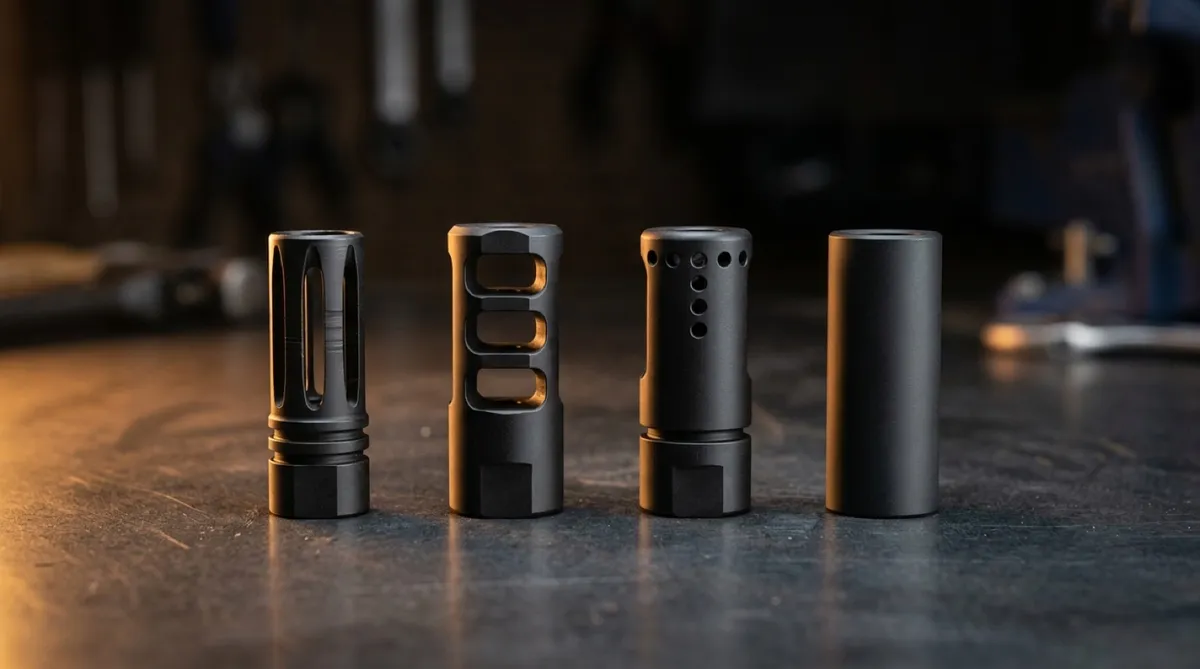
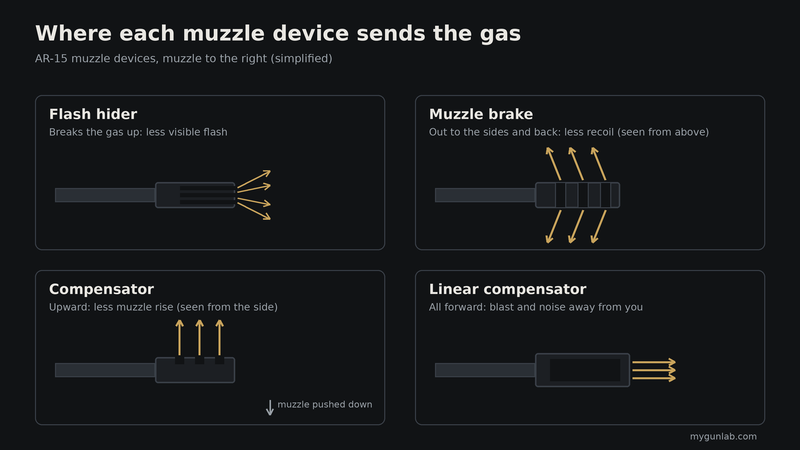
Short answer: all four screw onto the threaded end of the barrel and redirect the gas that follows the bullet; they differ in where they send it. A flash hider breaks up the gas so there's less visible flash. A muzzle brake vents it to the sides and back to cut felt recoil. A compensator vents it upward to stop the muzzle from climbing. A linear compensator sends it all forward, away from you. Many devices mix two jobs, which is why the names get blurred.
The four types at a glance
| Flash hider | Muzzle brake | Compensator | Linear compensator | |
|---|---|---|---|---|
| Main job | Less visible flash | Less recoil | Less muzzle rise | Blast and noise sent forward |
| Gas goes | Out the slots, broken up | Sideways and back | Up | Forward |
| Recoil | No change | Much less | A little less | No change |
| Loud for people beside you | Normal | Very | Louder | Quieter than bare |
| Typical price | $6-$70 | $20-$150 | $40-$130 | $20-$70 |
| Best for | General use, night, home defense | Competition, fast follow-up shots | Fast shooting, keeping the dot on target | Indoor ranges, short barrels, home defense |
Flash hider (flash suppressor)
A flash hider cools and breaks up the burning gas leaving the muzzle so you see less of a fireball, which matters most in low light: it protects your night vision and makes the shot less visible. It does little for recoil. The standard A2 birdcage flash hider that ships on most rifles is closed at the bottom, so it also stops the muzzle kicking up dust when you shoot prone and helps a little with muzzle rise. Three-prong hiders hide more flash. "Flash suppressor" means the same thing.
Muzzle brake
A brake has large side ports that throw the gas out sideways and slightly back, pulling the rifle forward against the recoil. It can cut felt recoil a lot, which is why competition shooters like them. The price is noise and blast: brakes are much louder for the people next to you, kick up dust, and can be rough to stand beside at an indoor range. They usually make more visible flash, not less.
Compensator
A compensator vents gas upward through ports on top, pushing the muzzle down so it stays on target between shots. Most AR-15 "comps" are really hybrids with both top and side ports, so you'll see "brake" and "compensator" used for the same device. If a listing mentions muzzle rise, it's acting as a compensator; if it mentions recoil, as a brake.
Linear compensator
A linear comp has a sleeve around the ports that turns all the gas forward. It doesn't reduce recoil, but it pushes the blast and noise away from you, which is why it's popular on short-barreled rifles, pistols and home-defense guns, and with anyone who shoots at an indoor range.
Which muzzle device should you choose?
- General use or a first build: an A2 birdcage. It's cheap, proven and works.
- Competition or fast shooting: a brake or brake/comp hybrid.
- Short barrel, indoor range or home defense: a linear comp or a good flash hider.
- Planning a suppressor: pick a flash hider or brake that doubles as that suppressor's mount.
Before you buy
- Thread pitch: 5.56 barrels are almost always 1/2x28, .30 calibers 5/8x24. See our thread size chart; a device made for a smaller bore is unsafe on a bigger caliber.
- Timing: brakes and comps must point their ports the right way. Use a crush washer or shims, and tighten to about 15-20 ft-lb (see torque specs).
- Barrel length: on a rifle, the barrel must be at least 16 inches. On a 14.5" barrel the device is pinned and welded to reach that length; a device you can unscrew doesn't count.
- State laws: some states restrict flash hiders on certain rifles but allow brakes or compensators. Check yours before you buy.
Compare AR-15 muzzle devices by price, or only the 1/2x28 (5.56) devices, and add one to your build in the AR-15 builder.
One of each, compared
Today's prices across the stores we track, all 1/2x28 for 5.56/.223:
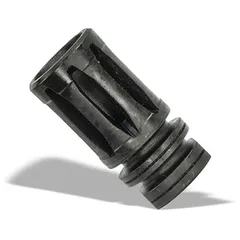
KAK A2 birdcage flash hider
Pros
- The standard flash hider
- Closed bottom, no dust kick-up when prone
- Costs a few dollars
Cons
- Doesn't reduce recoil
Flash hider
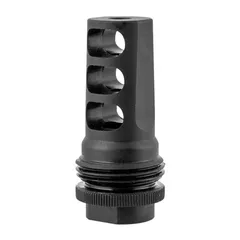
SilencerCo ASR 5.56 muzzle brake
Pros
- Cuts felt recoil
- Doubles as a SilencerCo ASR suppressor mount
Cons
- Loud for shooters beside you
Muzzle brake
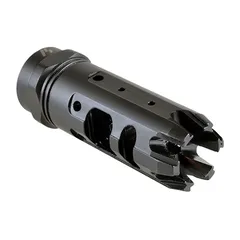
Strike Industries King Comp
Pros
- Keeps the muzzle down for fast follow-ups
- Good price for a comp
Cons
- Louder than a flash hider
Compensator
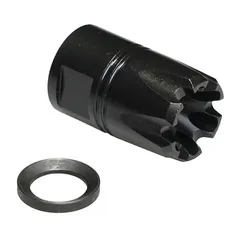
CMMG Zeroed linear compensator
Pros
- Sends blast and noise forward
- Good for short barrels and indoor ranges
Cons
- No recoil reduction
Linear compensator
Running a barrel under 16 inches? Read whether you still need Form 1 for an SBR first.
Some states name flash suppressors, brakes and compensators in their rifle definitions. See our featureless AR-15 guide for California, New York and New Jersey.
Frequently asked questions
What is the difference between a muzzle brake and a compensator?
A muzzle brake vents gas sideways and back to cut recoil; a compensator vents it upward to stop the muzzle from climbing. Many AR-15 devices do both.
What does a flash hider do?
It breaks up the burning gas at the muzzle so there's less visible flash, which protects your night vision and makes the shot harder to see. It does little for recoil.
Is a birdcage flash hider good enough?
For most rifles, yes. The A2 birdcage hides flash reasonably well, costs a few dollars and is the standard device on most AR-15s.
Are muzzle brakes louder?
Yes, especially for people beside you, because the gas is thrown sideways. A linear compensator does the opposite and sends the noise forward.
Can I put a 5.56 muzzle device on a 300 Blackout barrel?
No. 300 Blackout barrels are usually 5/8x24 and the bore is larger, so a 5.56 device can be struck by the bullet. Use a device made for .30 caliber.