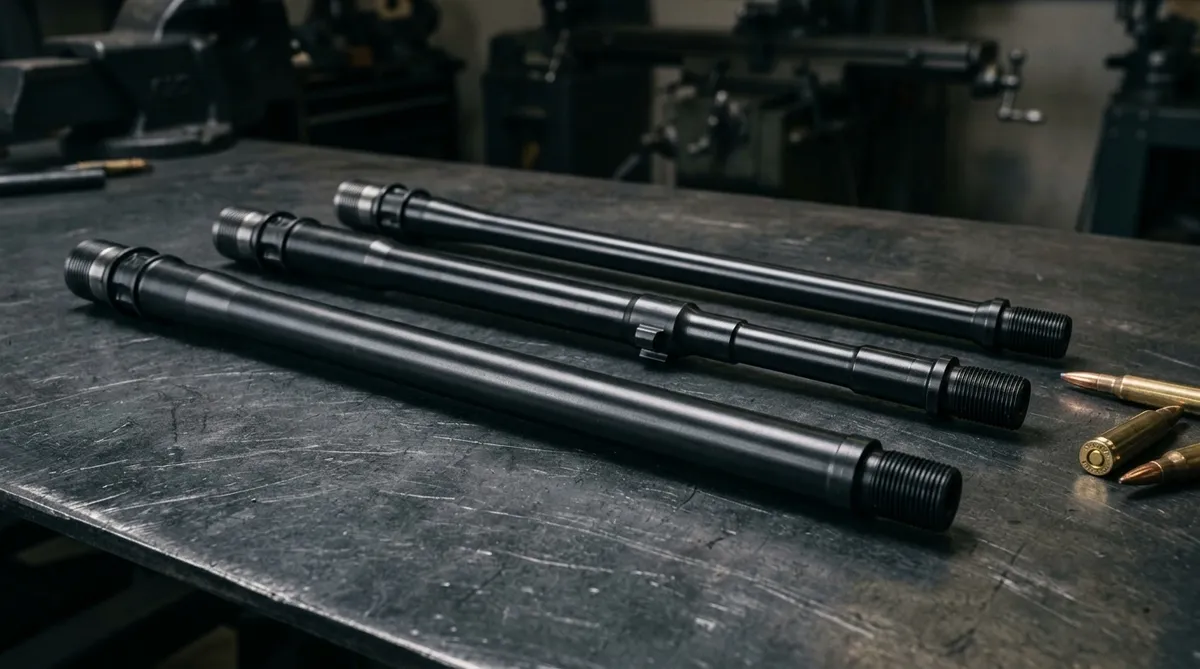
Short answer: the profile is the barrel's outside shape. Thin profiles (pencil, government) make a light, handy rifle; thick ones (heavy, bull) stay accurate as they heat up but weigh more. For twist, a 1:7 or 1:8 barrel handles every common 5.56 load from 55 to 77 grains; 1:9 suits bullets up to about 69 grains, and 1:12 only light ones.
Barrel profiles compared
| Profile | Shape | Good for | Trade-off |
|---|---|---|---|
| Pencil / lightweight | Thin all the way | Light carry and hunting builds | Heats up fast; point of impact can shift in long strings |
| Government (A2) | Thin under the handguard, thicker forward | General use | A little weight out front |
| M4 | Government with a cut for a grenade-launcher mount | Military-style clones | The cut adds nothing for civilian use |
| Medium / SOCOM | Thicker under the handguard | Hard use and duty rifles | Heavier than government |
| Heavy / HBAR | Thick all the way | Precision, varmint, target | Weight |
| Bull | Thickest, nearly straight | Bench and target shooting | Heaviest |
| Fluted | Heavy barrel with grooves cut in | A lighter heavy barrel | Costs more |
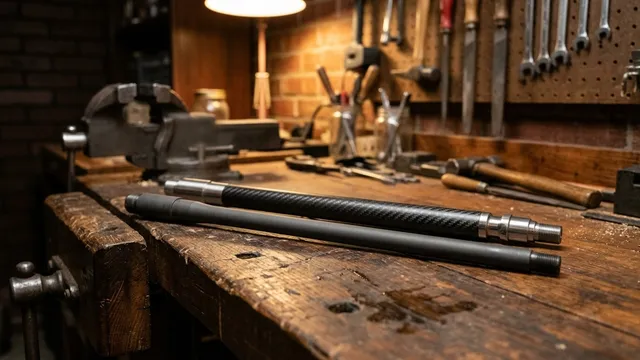
| Carbon fiber | Thin steel liner wrapped in carbon | Light and stiff | Costs the most |
Twist rate by caliber
Twist rate is how far the bullet travels for one full turn: 1:7 means one turn in 7 inches. Longer, heavier bullets need a faster twist (a smaller number) to stay stable.
| Caliber | Common twist | Bullet weights it suits |
|---|---|---|
| 5.56 / .223 | 1:7 | Every common load, including 77-grain match |
| 5.56 / .223 | 1:8 | 55 to 77 grains |
| 5.56 / .223 | 1:9 | Up to about 69 grains |
| 5.56 / .223 | 1:12 | 55 grains and lighter |
| 300 Blackout | 1:7 or 1:8 | 110-125 gr supersonic and 190-220 gr subsonic |
| .308 / 7.62x51 | 1:10 | Most loads, 150 to 175 grains |
| 6.5 Grendel | 1:8 | Most loads |
| 6.5 Creedmoor | 1:8 | Most loads, including heavy match bullets |
| 9mm (AR-9) | 1:10 | 115 to 147 grains |
What our catalog shows
As of October 2026, of the 5.56 barrels in our catalog whose twist appears in the name, 88 are 1:7 and 72 are 1:8: almost nobody sells 1:9 or 1:12 for new builds any more. A 1:7 barrel still shoots light 55-grain bullets well in most rifles.
Shop by profile and material: bull and heavy barrels, carbon fiber barrels, chrome-lined barrels, 10.5-inch barrels and 300 Blackout barrels. For gas system length, see gas systems explained; for muzzle threads, the thread size chart.
Picking a bullet weight? See published velocity, energy and drop for 55, 62 and 75 grain loads in our 5.56 ballistics chart.
Choosing a finish too? See chrome-lined vs nitride vs stainless AR-15 barrels.
Choosing a chamber too? Read 5.56 vs .223 vs .223 Wylde: can you mix them?
Ready to pick one? See the best AR-15 barrels, compared on maker specs.
Want a light barrel that stays stiff? See carbon fiber AR-15 barrels.
Frequently asked questions
Is a 1:7 or 1:8 twist better for 5.56?
Both handle the common 55 to 77 grain loads. 1:7 is the military standard and best for the heaviest bullets; 1:8 is a little more versatile with lighter bullets. Either is a safe choice.
Does barrel profile affect accuracy?
Mostly through heat: a heavier profile shifts less as it heats up over many shots. For a few shots from a cold barrel, a good light barrel can be just as accurate.
What does HBAR mean?
HBAR stands for heavy barrel: a thicker profile that stays stiff and accurate as it heats up, at the cost of weight.
What twist rate do I need for 77-grain bullets?
1:7 or 1:8 for 5.56. A 1:9 barrel usually won't stabilize them.
What twist rate for 300 Blackout subsonic ammo?
1:7 or 1:8, which stabilizes heavy 190 to 220 grain subsonic bullets as well as supersonic loads.
Sources: barrel and ammunition makers' published twist recommendations and the MyGunLab catalog. Check your ammo maker's recommendation for your barrel.