Short answer: put the butt stock in the pocket of your firing shoulder, bring the rifle up to your cheek, grip it high and about as firmly as a handshake, and hold the handguard as far forward as is comfortable. Stand with your legs staggered, knees slightly bent and upper body leaning a little forward. Press the trigger smoothly until the rifle fires, then zero your sights so the bullets land where you aim. These steps follow the Army's rifle and carbine manual, TC 3-22.9, adapted for a civilian at the range.
Safety first
The manual's four rules apply before anything else: treat every firearm as loaded, never point the muzzle at anything you do not intend to shoot, keep your finger straight and off the trigger until you are ready to fire, and be sure of your target and what is beyond it. Wear eye and ear protection, follow your range's rules, and if you are new, get a qualified instructor to watch you shoot.
Where your body meets the rifle
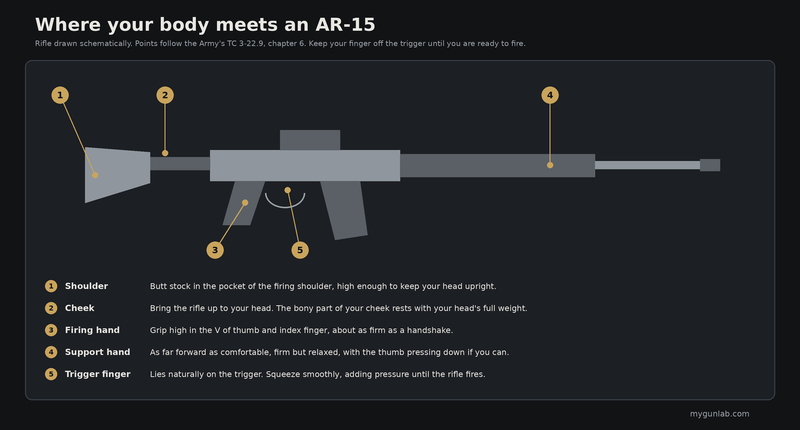
Stance
Standing without a rest, the manual has your legs staggered, knees slightly bent and upper body leaning slightly forward, which helps you manage recoil. Standing suits close targets or when you have no time for a steadier position. For more stability, go lower: the manual calls prone the most stable position, because so much of your body is on the ground.
Grip and support hand
Place the pistol grip high in the V between your thumb and index finger, with about the pressure of a firm handshake and no gap between your middle finger and the trigger guard. Keep your trigger finger along the lower receiver until you are ready to fire. Your support hand holds the rifle's weight on the handguard, as far forward as is comfortable, firm but relaxed. If you can, press down with that thumb to help control muzzle rise. A vertical or angled foregrip can help some shooters.
Shoulder and cheek
Set the butt stock high enough in your shoulder to keep your head upright. Bring the rifle up to your head, not your head down to the rifle, and let the full weight of your head rest with the bony part of your cheek on the stock. The goal is the same head position on every shot. A stock adjusted to fit you helps: see fixed vs collapsible stocks.
Find your natural point of aim
Relaxed muscles hold steadier than strained ones. To check your position, get steady on the target, close your eyes, take a breath, and open them at the natural pause. Where the sights have settled is your natural point of aim. If that is off the target, shift your position rather than muscling the rifle back.
Trigger
Let your finger lie naturally across the trigger; the manual sets no exact spot, because hands differ. Squeeze in a smooth, consistent motion, adding pressure until the rifle fires. Keep your eyes on the sights as you let the trigger reset. A smooth press matters at any speed.
How to zero
- Boresight. A laser boresighter gets your first shots on paper and saves ammunition.
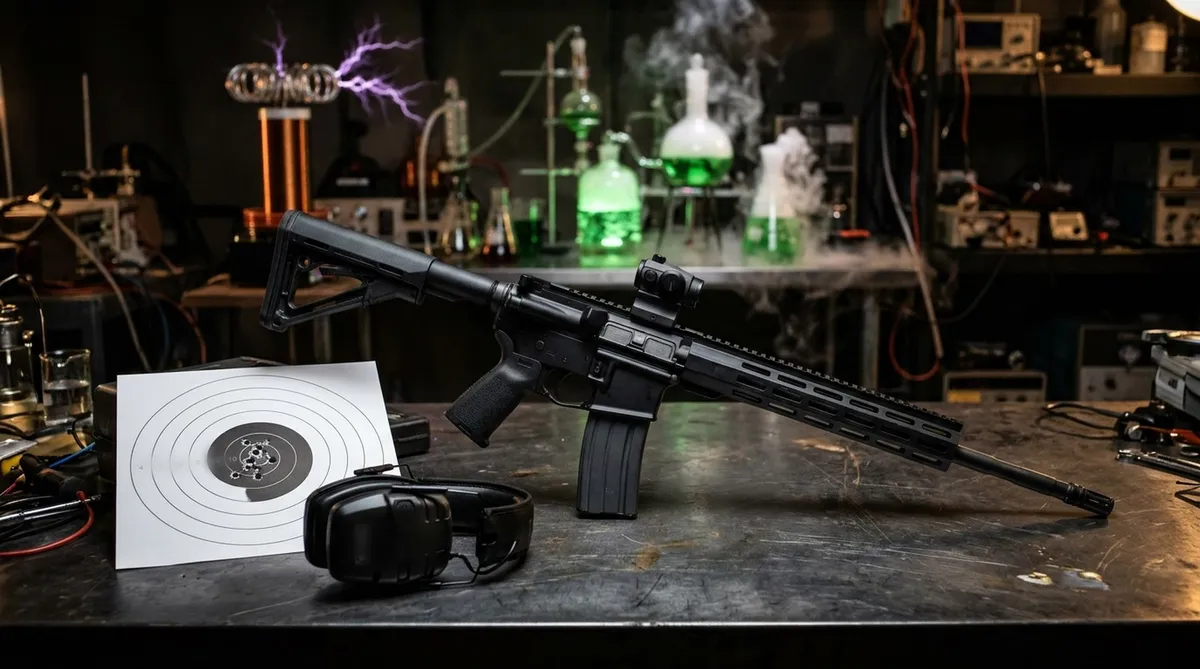
- Group. Fire a tight group first. The manual says not to start adjusting until you can group well, because you cannot zero a scattered pattern.
- Adjust. Move your sight using the click values in its manual to bring the center of the group to your aiming point.
- Confirm at distance. The Army zeroes at 25 meters and then confirms at 300, since a close zero alone does not guarantee a hit far away.
Many civilian shooters use a 50/200 yard zero, where the bullet crosses your line of sight near 50 yards and again near 200. Your real numbers depend on your barrel, ammunition and sight height, so confirm yours on paper. See the 5.56 ballistics chart.
A red dot, a sling and practice ammunition
A simple starting kit, lowest price across the stores we track. New to optics? See what a red dot is and how to choose a sling.
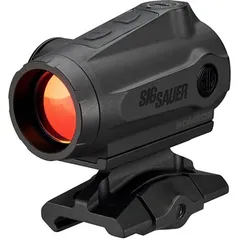
Sig Sauer Romeo5 Gen II 2 MOA
Pros
- Compact tube red dot, 2 MOA
Cons
- Green-dot model on this listing
Red dot
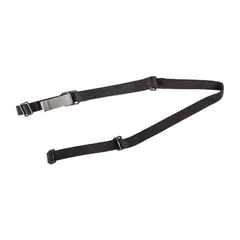
Blue Force Gear Vickers VCAS sling
Pros
- Two-point quick-adjust sling
Cons
- Two-point only
Sling

Federal American Eagle .223 55 gr FMJ
Pros
- Plain full metal jacket for practice
Cons
- Box of 20
Practice ammo
Still choosing a rifle? Start with the AR-15 guide, or price your own in the AR-15 builder.
Frequently asked questions
How do you hold an AR-15 properly?
Butt stock in your firing shoulder, cheek on the stock, firing hand high on the grip, and support hand as far forward on the handguard as is comfortable. Keep your finger off the trigger until you are ready to fire.
Where should your cheek go on an AR-15?
Rest the bony part of your cheek on the stock with your head's full weight, in the same place every shot. Bring the rifle to your head, not your head to the rifle.
What is the best stance for shooting an AR-15?
For standing, legs staggered, knees slightly bent and leaning slightly forward. Prone is the most stable position if you have time and room.
What distance should I zero an AR-15?
Many civilian shooters choose a 50/200 yard zero. The Army zeroes at 25 meters and confirms at 300. Whatever you choose, confirm it at distance.
How hard should you grip an AR-15?
About as firmly as a handshake with your firing hand, and firm but relaxed with your support hand.