Short answer (checked 11 October 2026): an "80% lower" is a marketing name for a partly finished AR-15 lower receiver, sold unserialized. Since ATF's 2022 rule, a partly finished receiver that can "readily" be completed counts as a firearm: it needs a serial number and must be sold through a licensed dealer with a background check. The Supreme Court upheld that rule on its face in Bondi v. VanDerStok (March 26, 2025, 7-2). On August 17, 2026 a Texas federal court held parts of the rule unconstitutional, but its order is limited to Defense Distributed, the Second Amendment Foundation and its members and the 1911 and G80 products in that case, and the rule still stands for everyone else, including AR-15 lowers. Federal law still lets a person who may legally own a gun make a non-NFA firearm for personal use, and many states are stricter.
This guide explains the law only. We do not give machining instructions. If you want to build an AR-15, the simple legal route is a serialized stripped lower bought through a dealer.
General information, not legal advice. The rules are changing; we re-check this guide every six months.
What is an 80% lower?
"80%" is not a legal term. It describes a lower receiver that is partly finished: shaped, but not completed to the point where a trigger group can be fitted. Sellers used the phrase to say the part was not yet a firearm, so it could ship without a serial number or a background check. ATF's 2022 rule changed what counts as a firearm, so the phrase now tells you less than it used to. The rule applies to receivers of any material or size.
How ATF decides if a partly finished receiver is a firearm
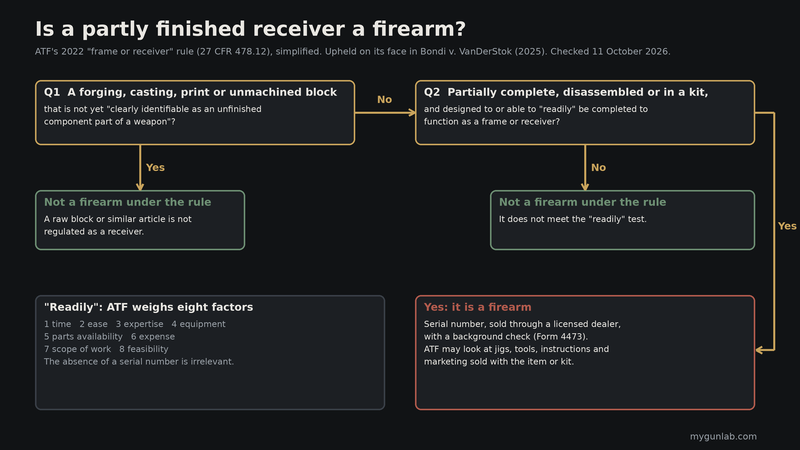
ATF's rule (27 CFR 478.12) says a "receiver" includes a partially complete, disassembled or nonfunctional receiver, or a parts kit, that is designed to or may readily be completed to function as one. It does not include a forging, casting, printing, extrusion or unmachined body that has not yet reached a stage where it is "clearly identifiable as an unfinished component part of a weapon." When ATF classifies an item it may also consider the templates, jigs, tools, instructions and marketing sold with it. "Readily" means fairly or reasonably efficient, quick and easy, and ATF weighs eight factors: time, ease, expertise, equipment, parts availability, expense, scope and feasibility. ATF says the absence of a serial number is irrelevant to whether something is a firearm. Source: ATF, Definition of "Frame or Receiver" and its final-rule Q&A.
The timeline: from the 2022 rule to August 2026
| Date | What happened |
|---|---|
| April 11, 2022 | The Attorney General signs ATF final rule 2021R-05F, Definition of "Frame or Receiver" and Identification of Firearms. It takes effect August 24, 2022. |
| March 26, 2025 | The Supreme Court decides Bondi v. VanDerStok, 7-2: the rule is "not facially inconsistent with the GCA". The Court says at least some weapon parts kits and partly complete frames or receivers are covered, and does not decide challenges to the rule as applied to particular kits. |
| August 17, 2026 | In Defense Distributed v. Blanche, a Texas federal judge holds parts of the rule unconstitutional and vague, but enjoins enforcement only against Defense Distributed, the Second Amendment Foundation and its members, and only for the products named in the case (reports; the order is not yet on ATF's site). |
What this means in practice
- Partly finished receivers and kits are firearms if they can readily be completed. They need a serial number and a dealer sale with a Form 4473 background check.
- Raw blocks and forgings that are not yet clearly identifiable as an unfinished weapon part are outside the rule, but ATF can look at what is sold with them.
- Making a firearm for yourself is still lawful federally. ATF's Q&A says it is not unlawful for a person who may legally possess firearms to make a non-NFA privately made firearm for personal use. Making short-barreled rifles and other NFA items has its own rules: see our SBR guide. Making guns as a business takes a license.
- The August 2026 ruling is narrow. It names an M1911 frame and a G80 build kit, not AR-15 lowers, and covers only the plaintiffs. The rule remains in the regulations for everyone else, and we have seen no appeal reported yet. Check back: this is moving.
- Many states go further. California, for example, requires you to apply to the state for a serial number before you manufacture or assemble a firearm, engrave it within 10 days and notify the state (Penal Code 29180). Other states ban or restrict unserialized or privately made firearms. Check your state before you buy or build anything.
- Prohibited persons may not possess firearms.
The legal route: buy a serialized lower
A stripped lower is a complete, serialized receiver with no parts fitted. It ships to a licensed dealer, you pass the check, and stripped lowers in our catalog start at about $63. A parts kit, an upper and the rest of the rifle follow in our lower assembly guide and how to build an AR-15; the AR-15 builder checks the parts fit. Four stripped lowers in stock today:
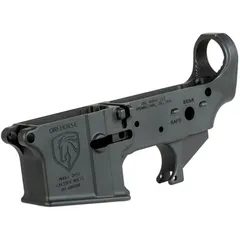
OH-15 multi-caliber stripped lower
Pros
- Lowest price we track
- Multi-caliber AR-15 lower
Cons
- Less known brand
Stripped lower
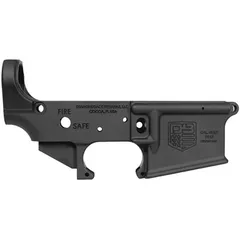
DB15 multi-caliber stripped lower
Pros
- Low price
- Standard AR-15 fit
Cons
- Parts kit extra
Stripped lower
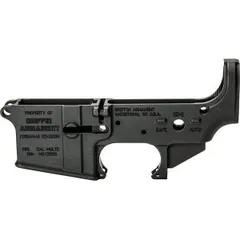
MK1 AR-15 stripped lower
Pros
- Mid-price mil-spec lower
- Standard AR-15 fit
Cons
- Parts kit extra
Stripped lower
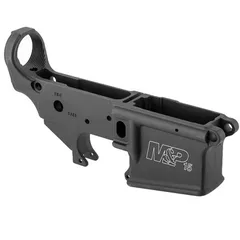
Smith & Wesson M&P15 stripped lower
Pros
- Name-brand lower
- Standard AR-15 fit
Cons
- Costs the most here
Stripped lower
Compare every lower receiver by price, and read our guides to AR-10 vs AR-15 parts and the AR pistol build if you are planning the rest of the rifle.
Frequently asked questions
What is an 80% lower?
A partly finished AR-15 lower receiver. "80%" is a sales term, not a legal one, and under ATF's 2022 rule many such parts count as firearms.
Are 80% lowers legal?
Federally, a partly finished receiver that can readily be completed is a firearm: it needs a serial number and a dealer sale. Making a non-NFA firearm for your own use is still lawful if you may legally own guns, but many states regulate or ban privately made firearms. Check yours.
Do 80% lowers need a serial number?
A partly finished receiver that counts as a firearm must carry one when a licensed maker or dealer handles it. Some states, such as California, also require a serial number on a firearm you make yourself.
What did Bondi v. VanDerStok decide?
On March 26, 2025 the Supreme Court held 7-2 that ATF's 2022 rule is not facially inconsistent with the Gun Control Act, so at least some weapon parts kits and partly complete frames or receivers are covered.
Did the August 2026 court ruling end the ATF rule?
No. A Texas federal court held parts of the rule unconstitutional but limited its order to Defense Distributed, the Second Amendment Foundation and its members, and the specific products in the case. The rule still applies to everyone else.
What is the legal way to build an AR-15 lower?
Buy a serialized stripped lower through a licensed dealer, then add a parts kit. See our lower assembly guide.