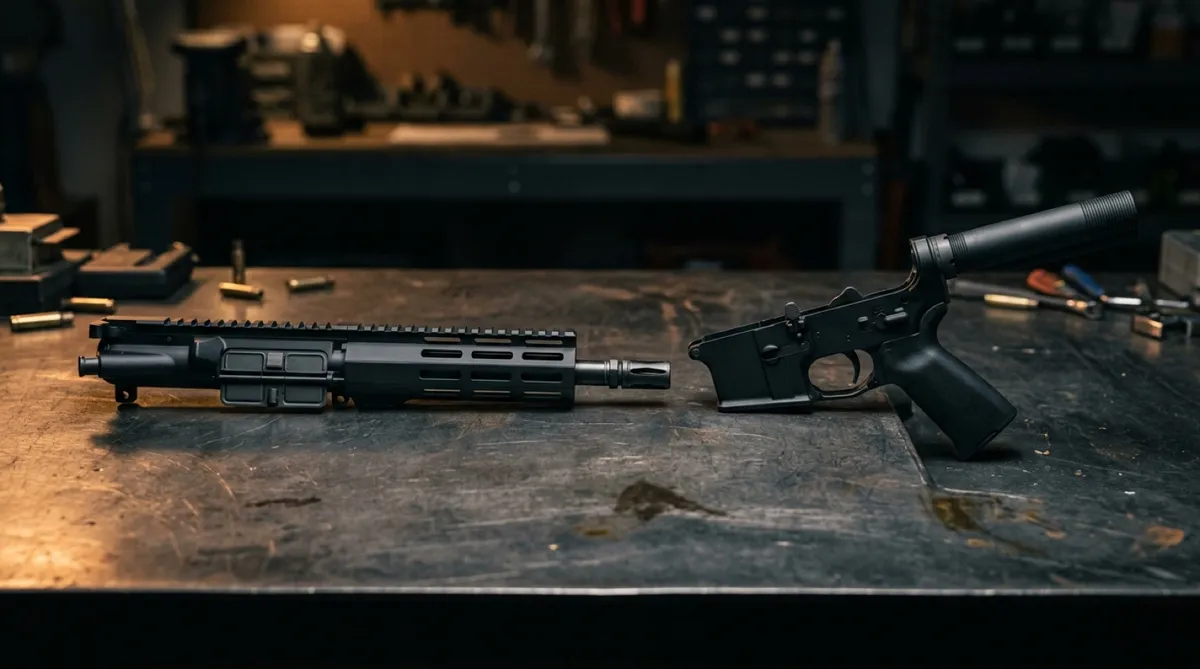
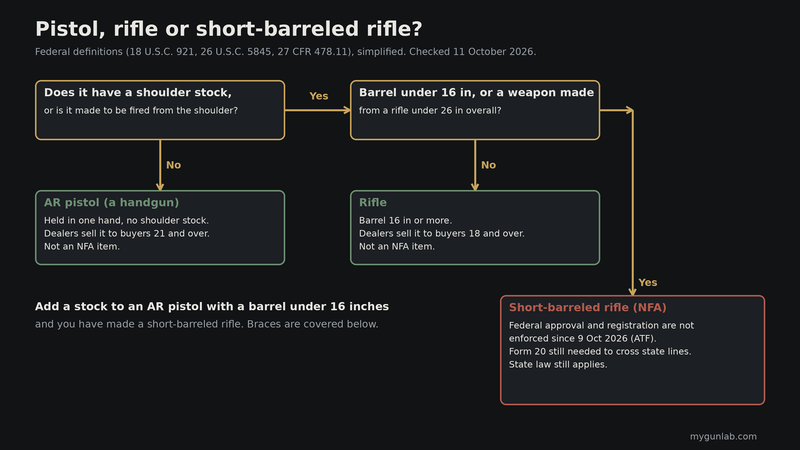
Short answer (checked 11 October 2026): an AR pistol is an AR-15 built as a handgun: a lower, a short barreled upper (usually 7 to 12 inches), and a pistol buffer tube with no shoulder stock. Federally it is a handgun, not an NFA item, so there is no tax stamp or registration, but dealers sell it only to buyers 21 and over and it ships to a dealer in your state. Add a stock to one with a barrel under 16 inches and you have made a short-barreled rifle; since October 9, 2026 ATF no longer enforces approval and registration for those, though state law still applies. The 2023 "pistol brace" rule was vacated in 2024, and ATF proposed removing it in May 2026.
This is general information, not legal advice. State laws on AR pistols vary: check yours before you buy or build. We re-check this guide every six months.
AR pistol vs rifle vs short-barreled rifle
| AR pistol | AR-15 rifle | AR-15 short-barreled rifle (SBR) | |
|---|---|---|---|
| Barrel | Any length; 7 to 12 inches is common | 16 inches or more | Under 16 inches |
| Shoulder stock | No | Yes | Yes |
| Federal classification | Handgun (Gun Control Act) | Rifle | NFA firearm |
| Buying from a dealer | 21 and over; ships to a dealer in your state | 18 and over | ATF has no dealer approval process yet and is not enforcing that rule meanwhile (see our SBR guide) |
| Tax stamp and registration | None | None | $0 tax; approval and registration not enforced since 9 Oct 2026 |
| Taking it across state lines | Ordinary handgun rules | Ordinary rifle rules | ATF Form 20 first |
The legal definitions are short. A pistol is a weapon originally designed, made and intended to fire when held in one hand, with a short stock gripped by one hand. A rifle is a weapon designed, made and intended to be fired from the shoulder. A rifle with a barrel under 16 inches, or a weapon made from a rifle that is under 26 inches overall, is a short-barreled rifle (26 U.S.C. 5845). Dealers may not sell a handgun to anyone under 21 or a rifle to anyone under 18, and may not sell a handgun to a resident of another state (18 U.S.C. 922(b)).
Parts you need to build an AR pistol
| Part | What to look for | Guide |
|---|---|---|
| Lower receiver | Any standard AR-15 lower. The lower is the firearm: it ships to a dealer. Buy a stripped lower and a parts kit, or a complete lower without a stock. | Lowers and assembling a lower |
| Pistol upper | A barrel from about 7 to 12.5 inches with a pistol or carbine gas system. Complete uppers are the easy route. | Uppers and gas system length |
| Pistol buffer tube | A plain tube with no stock on it. It may take a brace. Fit a stock only if you mean to build an SBR. | Buffer tubes and mil-spec vs commercial |
| Buffer and spring | Short barrels over-gas easily; a heavier buffer often helps. | Buffer weights |
| Bolt carrier group and charging handle | Standard 5.56 parts; many complete uppers leave them out. | BCG guide |
| Trigger and grip | The parts kit supplies both; upgrade the trigger if you like. | Install a trigger |
| Muzzle device | Short barrels are loud and bright; a flash hider or linear comp suits them. | Muzzle device guide |
| Magazines and optic | Standard 30-round AR magazines; a red dot is the usual sight on a pistol. | Magazines, optics |
Browse lowers, uppers, buffer tubes, magazines and optics, and read our guides to assembling a lower, gas system length, buffer weights and bolt carrier groups. Check the whole list in the AR-15 builder, which flags parts that do not fit together. Four building blocks, with today's prices:
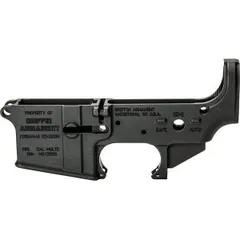
MK1 AR-15 stripped lower receiver
Pros
- Standard mil-spec lower
- Ships to a dealer, like any lower
Cons
- Needs a parts kit and a grip
Stripped lower
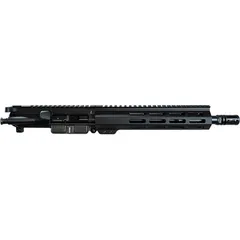
10.5" 5.56 pistol-length complete upper
Pros
- Short barrel with a pistol gas system
- Fully assembled upper
Cons
- Check what bolt carrier group it includes
Pistol upper
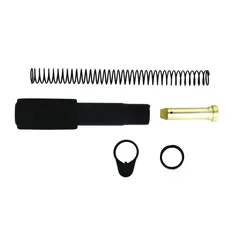
Tacfire mil-spec pistol buffer tube kit
Pros
- Tube, spring and buffer in one kit
- Low price
Cons
- No stock: brace is extra
Pistol buffer tube kit
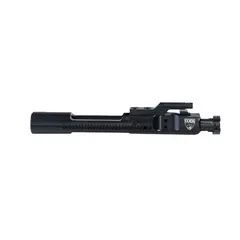
Faxon mil-spec nitride BCG
Pros
- Standard 5.56 BCG
- Works in any pistol upper
Cons
- Charging handle is extra
Bolt carrier group
How to build an AR pistol, step by step
- Buy the lower through a dealer. It is the firearm, so it must ship to a licensed dealer in your state, who runs the background check.
- Assemble the lower. Follow our lower assembly guide, and fit a pistol buffer tube, spring and buffer in place of a stock.
- Choose the upper. Pick a gas system length that suits the barrel length, and match the gas block to the barrel (see the gas system length chart).
- Fit the bolt carrier group and charging handle, then pin the upper to the lower.
- Function check. Unloaded, check the safety and trigger reset: our trigger guide shows how.
Stocks, braces and what changed in 2026
A stock makes it an SBR. A rifle with a barrel under 16 inches is a short-barreled rifle. Until recently that meant an ATF Form 1 and a $200 tax stamp. The tax is now $0 and, since October 9, 2026, ATF does not enforce the approval and registration rules for SBRs. Form 20 is still required to take one across state lines, and state law still applies. The details are in do you still need Form 1 for an SBR.
Braces. A pistol stabilizing brace straps to the forearm. In 2023 ATF issued a rule that treated many braced pistols as short-barreled rifles. Courts enjoined it and a federal court in Texas vacated it in June 2024. In May 2026 ATF published a proposal to remove the rule's language from its regulations; comments closed on August 4, 2026 and we found no final rule as of this guide. ATF says in that notice that it has never actively enforced the 2023 rule. The brace itself is legal to buy, and SBR rules are no longer enforced federally anyway, but the statutory definitions above still ask whether a weapon is designed and intended to be fired from the shoulder, and some states regulate braced pistols. A few options, with today's prices:
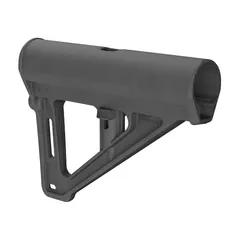
Magpul BTR pistol stabilizing brace
Pros
- Magpul quality
- Fits pistol buffer tubes
Cons
- Check your tube diameter
Brace
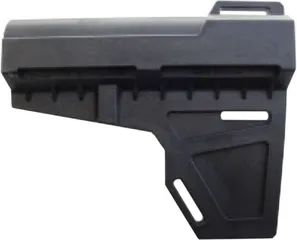
Shockwave Blade pistol stabilizer
Pros
- Low price
- Forearm brace
Cons
- Less adjustable
Brace
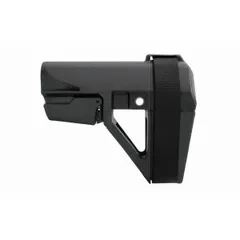
SBA5 5-position pistol stabilizing brace
Pros
- Five positions
- Adjustable length
Cons
- Costs more
Brace
Other rules to check before you build
- Vertical foregrips. The NFA's "any other weapon" definition excludes a rifled pistol, but ATF has treated a pistol with a vertical foregrip as no longer one-handed, and so as an "any other weapon". The courts have not always agreed. ATF does not enforce NFA rules for "any other weapons" since October 9, 2026, but an angled grip or no foregrip is the cautious choice, and state law can differ.
- State and local law. Some states ban or restrict AR pistols or their features, or tie possession to NFA registration; ATF says a minority of states ban NFA items outright. Check your state before you buy.
- Moving across state lines. A handgun must be bought through a dealer in your own state. Taking a pistol with a brace or stock across state lines can raise further rules: ask first.
Compare 10.5-inch barrels, buffer tubes and braces and stocks by price, or see our accessories checklist.
Thinking of making your own lower? See 80% lowers explained first.
Frequently asked questions
Is an AR pistol legal?
Under federal law an AR pistol is a handgun, not an NFA item, so it is legal for anyone who may own a handgun. Some states restrict AR pistols, so check your state first.
What is the difference between an AR pistol and an AR-15 rifle?
A pistol has no shoulder stock and is made to be fired from the hand. A rifle has a stock and a barrel of 16 inches or more. The same lower can be built either way.
Can I put a stock on my AR pistol?
If the barrel is under 16 inches, a stock makes it a short-barreled rifle. Since October 9, 2026 ATF has not enforced the federal approval and registration rules for that, but state law still applies.
Do I need a tax stamp for an AR pistol?
No. A pistol is not an NFA item. The NFA tax on short-barreled rifles is also $0 since January 1, 2026.
Are pistol braces legal?
Braces are legal to buy. The 2023 ATF brace rule was vacated in 2024 and ATF proposed removing it in May 2026; state laws may still restrict braced pistols.
How old do you have to be to buy an AR pistol?
21 from a licensed dealer, because it is a handgun. A rifle is 18.
What barrel length is best for an AR pistol?
It depends on what you want. Barrels of about 7 to 12.5 inches with a pistol or carbine gas system are common on AR pistols; shorter barrels are louder and give up more velocity.